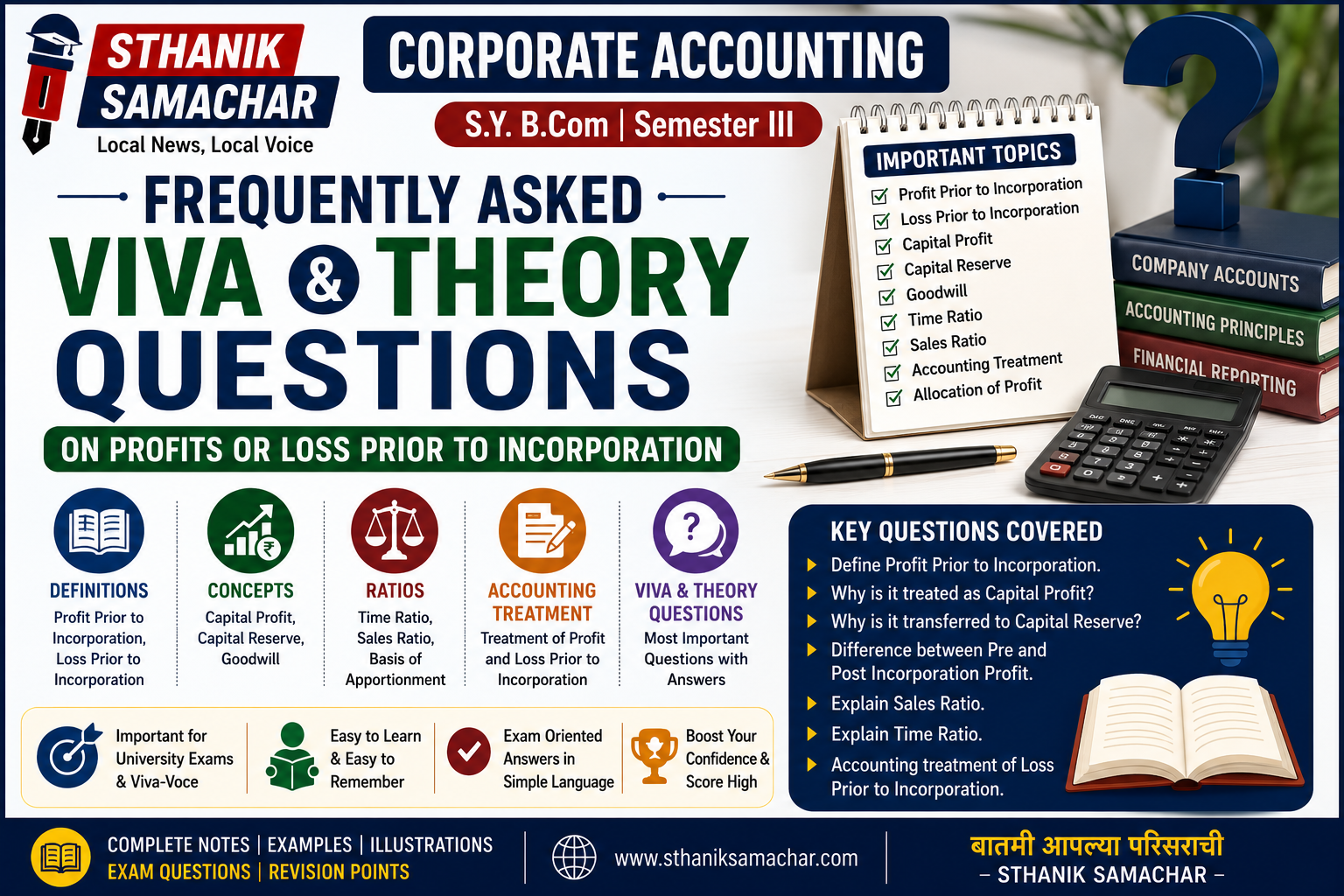
Comprehensive S.Y. B.Com Semester III study material featuring Frequently Asked Viva and Theory Questions on Profits or Loss Prior to Incorporation. Ideal for university exams, internal assessments, and viva-voce preparation.
Introduction
The chapter “Profits or Loss Prior to Incorporation” is one of the most important topics in Corporate Accounting for S.Y. B.Com Semester III. It is frequently asked in university theory examinations, viva-voce, internal assessments, and competitive examinations. Students are expected not only to solve numerical problems but also to explain theoretical concepts clearly and confidently.
This article presents the most frequently asked viva and theory questions along with comprehensive answers in a simple and examination-oriented manner.
1. Define Profit Prior to Incorporation.
Answer
Profit Prior to Incorporation refers to the profit earned by a business from the date of acquisition (purchase of business) to the date of incorporation of the company.
Since the company did not legally exist during this period, such profit is not considered an operating profit of the company. Therefore, it is treated as Capital Profit.
Example
A company purchases a business on 1 January but is incorporated on 1 April. Any profit earned between 1 January and 31 March is known as Profit Prior to Incorporation.
2. Define Loss Prior to Incorporation.
Answer
Loss Prior to Incorporation is the loss incurred by the business during the period between the date of acquisition and the date of incorporation.
Since this loss relates to the period before the company came into legal existence, it is treated as a Capital Loss rather than a Revenue Loss.
3. Why is Profit Prior to Incorporation Treated as Capital Profit?
Answer
Profit Prior to Incorporation is treated as Capital Profit because:
- The company had not yet become a separate legal entity.
- The company was incapable of earning business income before incorporation.
- The profit actually belonged to the business acquired from the vendor.
- It represents a reduction in the purchase cost of the business rather than operating income.
- It is not generated through the company’s trading activities after incorporation.
Therefore, it is classified as a Capital Profit.
4. Why is Profit Prior to Incorporation Transferred to Capital Reserve?
Answer
Profit Prior to Incorporation is transferred to Capital Reserve because:
- It is a capital gain and not a revenue profit.
- It cannot be distributed as dividend among shareholders.
- It strengthens the financial position of the company.
- It may be utilized for writing off capital losses, goodwill, preliminary expenses, or issuing bonus shares, subject to legal provisions.
Thus, Capital Reserve represents accumulated capital profits.
5. Why Can’t Profit Prior to Incorporation be Distributed as Dividend?
Answer
Dividend can be declared only from Revenue Profits earned after incorporation.
Since Profit Prior to Incorporation:
- Was earned before the company legally existed,
- Is classified as Capital Profit,
- Does not arise from normal business operations,
it cannot be distributed as dividend.
6. What is Capital Reserve?
Answer
Capital Reserve is a reserve created from Capital Profits rather than normal trading profits.
Examples include:
- Profit Prior to Incorporation
- Profit on sale of Fixed Assets
- Securities Premium (subject to legal provisions)
Capital Reserve is shown under Reserves and Surplus in the Balance Sheet.
7. What is Goodwill?
Answer
Goodwill is an intangible asset representing the reputation, customer loyalty, brand value, and earning capacity of a business.
Loss Prior to Incorporation is often debited to Goodwill because it is considered part of the acquisition cost of the business.
8. What is Time Ratio?
Answer
Time Ratio is the ratio between the duration of the Pre-Incorporation Period and the Post-Incorporation Period.
Formula
Time Ratio = Pre-Incorporation Period : Post-Incorporation Period
Example
Pre-Incorporation = 3 months
Post-Incorporation = 9 months
Time Ratio = 3 : 9 = 1 : 3
Time Ratio is generally used for:
- Rent
- Salaries
- Insurance
- Office Expenses
- Depreciation
9. What is Sales Ratio?
Answer
Sales Ratio is the ratio of sales during the Pre-Incorporation Period to the sales during the Post-Incorporation Period.
Formula
Sales Ratio = Pre-Incorporation Sales : Post-Incorporation Sales
Example
Pre Sales = ₹8,00,000
Post Sales = ₹24,00,000
Sales Ratio = 1 : 3
Sales Ratio is used for:
- Gross Profit
- Advertisement
- Sales Commission
- Selling Expenses
- Bad Debts
10. Why is Gross Profit Allocated on Sales Ratio?
Answer
Gross Profit depends directly on the amount of sales made.
If sales are higher in one period, Gross Profit will also be higher.
Therefore, Gross Profit is allocated on the Sales Ratio rather than the Time Ratio.
11. Why are Administrative Expenses Allocated on Time Ratio?
Answer
Administrative expenses such as rent, salaries, insurance, and office expenses are incurred evenly throughout the accounting year.
Since these expenses do not depend on sales, they are allocated on the basis of the Time Ratio.
12. Why are Audit Fees Allocated to the Post-Incorporation Period?
Answer
Audit Fees relate to the statutory audit of the company.
As a company comes into existence only after incorporation, Audit Fees are entirely charged to the Post-Incorporation Period.
13. Why are Directors’ Fees Allocated Only After Incorporation?
Answer
Directors are appointed only after the company is incorporated.
Therefore, Directors’ Fees relate exclusively to the Post-Incorporation Period and are not apportioned.
14. Why is Partners’ Salary Allocated to the Pre-Incorporation Period?
Answer
Before incorporation, the business belongs to the partners.
After incorporation, the company becomes a separate legal entity.
Therefore, Partners’ Salary relates only to the Pre-Incorporation Period.
15. What is the Difference Between Pre-Incorporation Profit and Post-Incorporation Profit?
| Basis | Pre-Incorporation Profit | Post-Incorporation Profit |
|---|---|---|
| Meaning | Profit earned before incorporation | Profit earned after incorporation |
| Nature | Capital Profit | Revenue Profit |
| Legal Status | Before company existed | After company was formed |
| Dividend | Cannot be distributed | Can be distributed |
| Accounting Treatment | Transferred to Capital Reserve | Transferred to Profit & Loss Appropriation Account |
| Balance Sheet | Capital Reserve | Surplus/Retained Earnings |
16. Explain the Accounting Treatment of Profit Prior to Incorporation.
Answer
The accounting treatment is:
- Determine the amount through the Allocation Statement.
- Transfer it to Capital Reserve.
- Do not distribute it as dividend.
- Show it under Reserves and Surplus in the Balance Sheet.
Journal Entry
Profit & Loss Account Dr.
To Capital Reserve Account
17. Explain the Accounting Treatment of Loss Prior to Incorporation.
Answer
Loss Prior to Incorporation is treated as Capital Loss.
It may be:
- Debited to Goodwill, or
- Adjusted against Capital Reserve, if available.
Journal Entry
Goodwill Account Dr.
To Profit & Loss Account
18. What is the Purpose of Preparing a Statement Showing Allocation of Profit?
Answer
The statement is prepared to:
- Divide annual profit into two periods.
- Determine Capital Profit and Revenue Profit.
- Allocate incomes and expenses correctly.
- Facilitate proper accounting treatment.
- Prepare accurate financial statements.
19. What are the Bases of Apportionment?
Answer
Three main bases are used:
- Time Ratio
- Sales Ratio
- Specific Allocation
Each income or expense is allocated according to its nature.
20. What are the Advantages of Correct Apportionment?
Answer
Correct apportionment:
- Ensures accurate determination of Capital and Revenue Profit.
- Prevents incorrect declaration of dividends.
- Facilitates proper accounting treatment.
- Improves reliability of financial statements.
- Ensures compliance with accounting principles.
- Helps students solve practical problems accurately.
Additional Viva Questions
Very Short Questions
- What is the Date of Incorporation?
- What is the Date of Acquisition?
- What is Capital Profit?
- What is Revenue Profit?
- What is Capital Loss?
- What is Revenue Loss?
- Which ratio is used for Rent?
- Which ratio is used for Gross Profit?
- Where is Capital Reserve shown?
- Where is Goodwill shown?
- Can Capital Profit be distributed as dividend?
- Which expenses are allocated using Sales Ratio?
- Which expenses are allocated using Time Ratio?
- What is Specific Allocation?
- Why is Goodwill an Intangible Asset?
Frequently Asked University Theory Questions
- Define Profit Prior to Incorporation.
- Explain the need for calculating Pre-Incorporation Profit.
- Distinguish between Pre-Incorporation Profit and Post-Incorporation Profit.
- Explain Time Ratio with an illustration.
- Explain Sales Ratio with an illustration.
- Discuss the Basis of Apportionment of Expenses.
- Explain the Accounting Treatment of Profit Prior to Incorporation.
- Explain the Accounting Treatment of Loss Prior to Incorporation.
- Explain the preparation of a Statement Showing Allocation of Profit.
- Discuss the role of Capital Reserve and Goodwill in Corporate Accounting.
Examination Tips
- Learn the definitions exactly as prescribed in accounting terminology.
- Understand the logic behind each accounting treatment rather than memorizing it.
- Remember which items are allocated on Time Ratio, Sales Ratio, and Specific Allocation.
- Practice writing short answers in 3–5 points for theory questions.
- Revise journal entries and Balance Sheet presentation before examinations.
Key Points to Remember
- Profit Prior to Incorporation is a Capital Profit.
- Loss Prior to Incorporation is a Capital Loss.
- Capital Profit is transferred to Capital Reserve.
- Capital Loss is generally debited to Goodwill.
- Gross Profit is allocated on the Sales Ratio.
- Administrative expenses are allocated on the Time Ratio.
- Audit Fees and Directors’ Fees belong to the Post-Incorporation Period.
- Partners’ Salary belongs to the Pre-Incorporation Period.
- Only Revenue Profit is available for dividend distribution.
Summary
The chapter Profits or Loss Prior to Incorporation combines theoretical concepts with practical accounting applications. Understanding the definitions, reasons for treating pre-incorporation profit as Capital Profit, the importance of Capital Reserve, the role of Goodwill, and the concepts of Time Ratio, Sales Ratio, and Specific Allocation is essential for success in university examinations and viva-voce. Regular practice of these frequently asked questions enables students to build conceptual clarity, improve confidence, and answer both theory and practical questions accurately.

प्रकाश खिलारे हे स्थानिक समाचार डिजिटल मीडिया चे सहसंपादक असून सामाजिक, राजकीय, शैक्षणिक आणि स्थानिक घडामोडींवरील बातम्यांचे वृत्तांकन करतात. जनसामान्यांच्या प्रश्नांना वाचा फोडणे, स्थानिक पातळीवरील महत्त्वाच्या घटनांची अचूक माहिती वाचकांपर्यंत पोहोचवणे आणि निष्पक्ष पत्रकारितेच्या माध्यमातून समाजाशी जोडलेले राहणे हा त्यांच्या लेखनाचा मुख्य उद्देश आहे. डिजिटल पत्रकारितेच्या माध्यमातून ते विविध विषयांवर सखोल आणि प्रभावी बातम्या प्रकाशित करतात. आपण आपल्या परिसरातील बातम्या, माहिती तसेच लेख देण्याकरिता संपर्क करू शकतात…..
मो. 9112225235
Email- prakaashkhilare@gmail.com