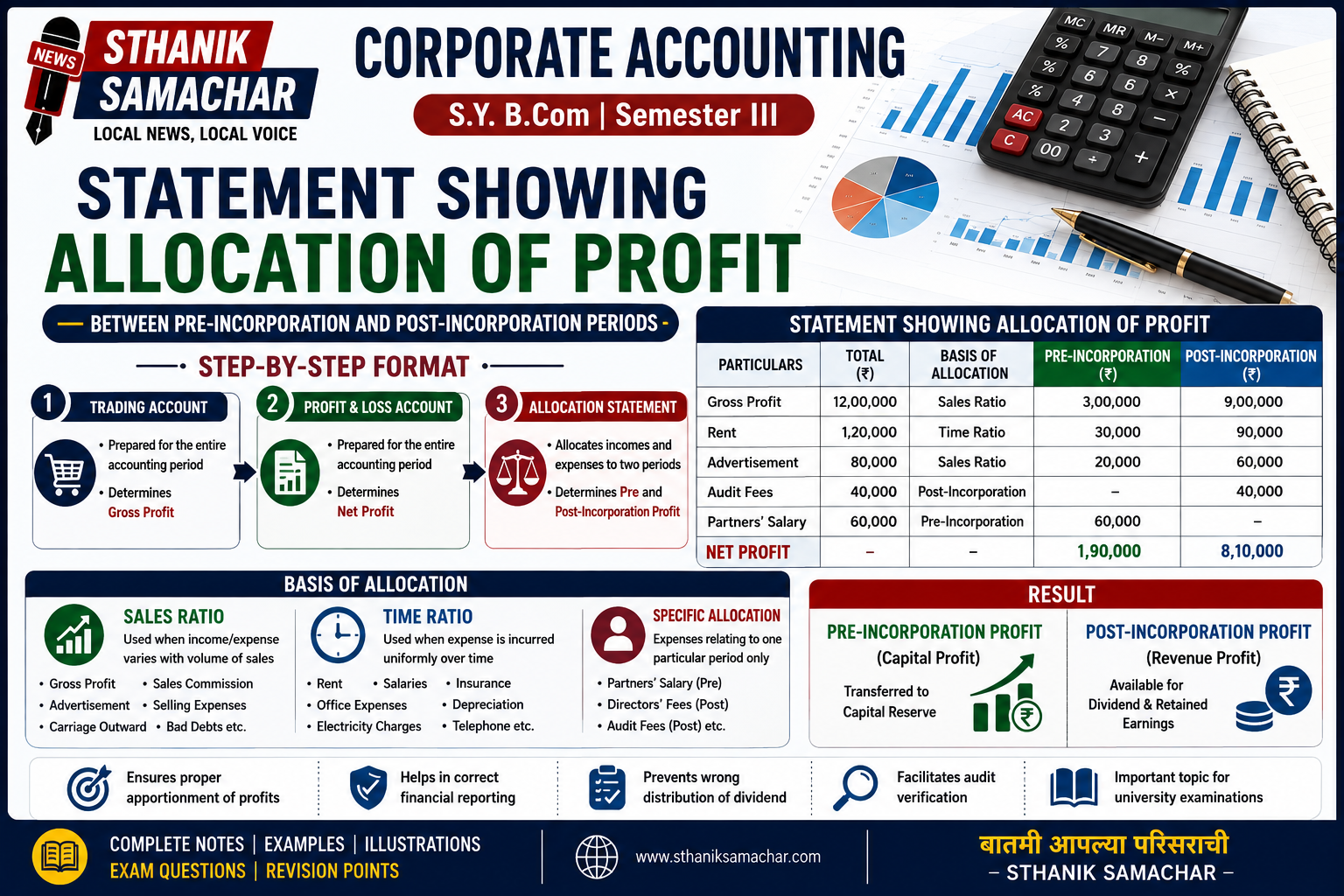
Comprehensive Corporate Accounting notes on the Statement Showing Allocation of Profit. Explore the preparation of the Trading Account, Profit & Loss Account, and Allocation Statement to determine pre-incorporation and post-incorporation profits accurately.
Learning Objectives
After studying this article, students will be able to:
- Understand the purpose of preparing a Statement Showing Allocation of Profit.
- Learn the step-by-step procedure for calculating Pre-Incorporation and Post-Incorporation Profit.
- Prepare the Trading Account and Profit & Loss Account for the entire accounting period.
- Allocate incomes and expenses using Time Ratio, Sales Ratio, and Specific Allocation.
- Prepare the Statement Showing Allocation of Profit in the prescribed format.
- Solve university examination problems confidently.
Introduction
When a company purchases an existing business before its incorporation, the financial results for the accounting year relate to two distinct periods:
- Pre-Incorporation Period
- Post-Incorporation Period
The Trading Account and Profit & Loss Account are prepared for the entire accounting year because separate books of account are generally not maintained for each period. However, for accounting purposes, it is necessary to determine how much profit belongs to each period.
This is achieved by preparing a Statement Showing Allocation of Profit, which distributes Gross Profit, expenses, and Net Profit between the pre-incorporation and post-incorporation periods using appropriate bases of apportionment.
The preparation of this statement is one of the most important practical topics in Corporate Accounting and is frequently asked in university examinations.
What is a Statement Showing Allocation of Profit?
A Statement Showing Allocation of Profit is a working statement prepared to divide the total profit of the accounting year into:
- Profit Prior to Incorporation (Capital Profit)
- Profit After Incorporation (Revenue Profit)
The statement is prepared after the Trading Account and Profit & Loss Account and serves as the basis for determining the correct accounting treatment of profits.
Steps in Preparing the Statement Showing Allocation of Profit
The preparation of the statement involves three important stages:
Step 1 – Prepare the Trading Account
The Trading Account is prepared for the entire accounting period.
Its objective is to determine the Gross Profit or Gross Loss of the business.
The Gross Profit is then apportioned between the pre-incorporation and post-incorporation periods, generally on the basis of the Sales Ratio, because Gross Profit depends on the volume of sales.
Format of Trading Account
| Trading Account | Amount (₹) | Amount (₹) |
|---|---|---|
| Particulars | Debit | Credit |
| Opening Stock | xxx | |
| Purchases | xxx | |
| Direct Expenses | xxx | |
| Carriage Inward | xxx | |
| Wages | xxx | |
| Gross Profit c/d | xxx | |
| Sales xxx | ||
| Closing Stock xxx |
The Gross Profit calculated here is transferred to the Profit & Loss Account.
Step 2 – Prepare the Profit & Loss Account
The Profit & Loss Account is also prepared for the entire accounting year.
Its purpose is to determine the Net Profit after deducting indirect expenses from the Gross Profit.
However, since the Profit & Loss Account includes expenses relating to both periods, each item must later be allocated appropriately.
Format of Profit & Loss Account
| Profit & Loss Account | Amount (₹) | Amount (₹) |
|---|---|---|
| Particulars | Debit | Credit |
| Salaries | xxx | |
| Rent | xxx | |
| Insurance | xxx | |
| Advertisement | xxx | |
| Office Expenses | xxx | |
| Depreciation | xxx | |
| Audit Fees | xxx | |
| Directors’ Fees | xxx | |
| Net Profit | xxx | |
| Gross Profit b/d xxx | ||
| Other Income xxx |
The total Net Profit shown here relates to the entire accounting year and must be apportioned.
Step 3 – Prepare the Statement Showing Allocation of Profit
After preparing the Trading Account and Profit & Loss Account, each item is allocated between the two periods.
This allocation is based on:
- Sales Ratio
- Time Ratio
- Specific Allocation
The statement clearly shows the amount of profit belonging to each period.
Basis of Allocation
The following principles are generally followed:
Allocated on Sales Ratio
- Gross Profit
- Sales Commission
- Advertisement
- Selling Expenses
- Carriage Outward
- Bad Debts
- Discount Allowed
Allocated on Time Ratio
- Rent
- Salaries
- Office Expenses
- Insurance
- Depreciation
- Telephone Expenses
- Electricity Charges
Specific Allocation
Pre-Incorporation
- Partners’ Salary
- Partners’ Commission
- Vendor’s Interest
Post-Incorporation
- Directors’ Fees
- Audit Fees
- Preliminary Expenses
- Debenture Interest
- Company Formation Expenses
Step-by-Step Illustration
Suppose:
- Date of Purchase = 1 January 2026
- Date of Incorporation = 1 April 2026
- Accounting Year Ends = 31 December 2026
Time Ratio
3 : 9
= 1 : 3
Sales Ratio
₹8,00,000 : ₹24,00,000
= 1 : 3
Gross Profit
₹12,00,000
Rent
₹1,20,000
Advertisement
₹80,000
Audit Fees
₹40,000
Partners’ Salary
₹60,000
Statement Showing Allocation of Profit
| Particulars | Total (₹) | Basis | Pre-Incorporation (₹) | Post-Incorporation (₹) |
|---|---|---|---|---|
| Gross Profit | 12,00,000 | Sales Ratio | 3,00,000 | 9,00,000 |
| Rent | 1,20,000 | Time Ratio | 30,000 | 90,000 |
| Advertisement | 80,000 | Sales Ratio | 20,000 | 60,000 |
| Audit Fees | 40,000 | Post-Incorporation | — | 40,000 |
| Partners’ Salary | 60,000 | Pre-Incorporation | 60,000 | — |
| Net Profit | 1,90,000 | 8,10,000 |
Interpretation of the Statement
From the above statement:
- ₹1,90,000 represents Profit Prior to Incorporation.
- ₹8,10,000 represents Profit After Incorporation.
The accounting treatment will be:
- ₹1,90,000 → Capital Reserve
- ₹8,10,000 → Revenue Profit, available for dividend and retained earnings.
Advantages of Preparing the Statement
Preparing the Statement Showing Allocation of Profit offers several advantages:
- Ensures proper classification of Capital and Revenue Profit.
- Facilitates accurate accounting treatment.
- Prevents incorrect declaration of dividends.
- Provides reliable financial information.
- Assists auditors during verification.
- Simplifies the preparation of Balance Sheet.
- Ensures compliance with accounting standards and company law.
- Improves the accuracy of financial reporting.
Practical Examination Approach
Students should follow the following sequence while solving practical questions:
- Identify the Date of Purchase.
- Identify the Date of Incorporation.
- Calculate the Time Ratio.
- Calculate the Sales Ratio.
- Prepare the Trading Account.
- Prepare the Profit & Loss Account.
- Determine the basis of allocation for each item.
- Prepare the Statement Showing Allocation of Profit.
- Determine Pre-Incorporation Profit.
- Determine Post-Incorporation Profit.
- Pass the necessary journal entries.
Following this systematic approach helps avoid mistakes and ensures full marks in practical examinations.
Common Mistakes Made by Students
Students frequently commit the following errors:
- Using Time Ratio for Gross Profit instead of Sales Ratio.
- Allocating Audit Fees to both periods.
- Allocating Partners’ Salary after incorporation.
- Ignoring Specific Allocation items.
- Calculating incorrect Time Ratio.
- Forgetting to prepare the Allocation Statement.
- Incorrect totaling of allocated amounts.
Avoiding these mistakes significantly improves examination performance.
Examination Tips
- Always calculate Time Ratio and Sales Ratio before preparing the statement.
- Learn the basis of allocation for common items.
- Present the statement in a tabular format.
- Clearly mention the basis of allocation for every item.
- Double-check totals after allocation.
- Remember that only Revenue Profit can be distributed as dividend.
Key Points to Remember
- The Trading Account and Profit & Loss Account are prepared for the entire accounting period.
- The Statement Showing Allocation of Profit divides total profit into Pre-Incorporation and Post-Incorporation Profit.
- Gross Profit is generally allocated using the Sales Ratio.
- Administrative expenses are allocated using the Time Ratio.
- Certain items require Specific Allocation.
- Profit Prior to Incorporation is transferred to Capital Reserve.
- Profit After Incorporation is treated as Revenue Profit.
Examination-Oriented Questions
Very Short Answer Questions
- What is a Statement Showing Allocation of Profit?
- Why is Gross Profit apportioned on the Sales Ratio?
- Which expenses are allocated on the Time Ratio?
- Why are Audit Fees specifically allocated to the Post-Incorporation Period?
- Where is Profit Prior to Incorporation transferred?
Short Answer Questions
- Explain the steps involved in preparing a Statement Showing Allocation of Profit.
- Discuss the importance of preparing an Allocation Statement.
- Explain the basis of allocating Gross Profit and administrative expenses.
Long Answer Question
Explain the preparation of the Statement Showing Allocation of Profit between the Pre-Incorporation and Post-Incorporation periods. Discuss the role of the Trading Account, Profit & Loss Account, and Allocation Statement with suitable illustrations.
Summary
The Statement Showing Allocation of Profit is a vital working statement in Corporate Accounting that separates the total annual profit into Pre-Incorporation Profit and Post-Incorporation Profit. The process begins with preparing the Trading Account to determine Gross Profit, followed by the Profit & Loss Account to calculate Net Profit for the entire accounting year. The final step is the Allocation Statement, where each income and expense is distributed using Sales Ratio, Time Ratio, or Specific Allocation, depending on its nature. This systematic approach ensures accurate determination of Capital Profit and Revenue Profit, supports proper accounting treatment, and enhances the reliability of financial statements. Mastery of this topic is essential for university examinations and forms the foundation for solving practical problems in Corporate Accounting.

प्रकाश खिलारे हे स्थानिक समाचार डिजिटल मीडिया चे सहसंपादक असून सामाजिक, राजकीय, शैक्षणिक आणि स्थानिक घडामोडींवरील बातम्यांचे वृत्तांकन करतात. जनसामान्यांच्या प्रश्नांना वाचा फोडणे, स्थानिक पातळीवरील महत्त्वाच्या घटनांची अचूक माहिती वाचकांपर्यंत पोहोचवणे आणि निष्पक्ष पत्रकारितेच्या माध्यमातून समाजाशी जोडलेले राहणे हा त्यांच्या लेखनाचा मुख्य उद्देश आहे. डिजिटल पत्रकारितेच्या माध्यमातून ते विविध विषयांवर सखोल आणि प्रभावी बातम्या प्रकाशित करतात. आपण आपल्या परिसरातील बातम्या, माहिती तसेच लेख देण्याकरिता संपर्क करू शकतात…..
मो. 9112225235
Email- prakaashkhilare@gmail.com