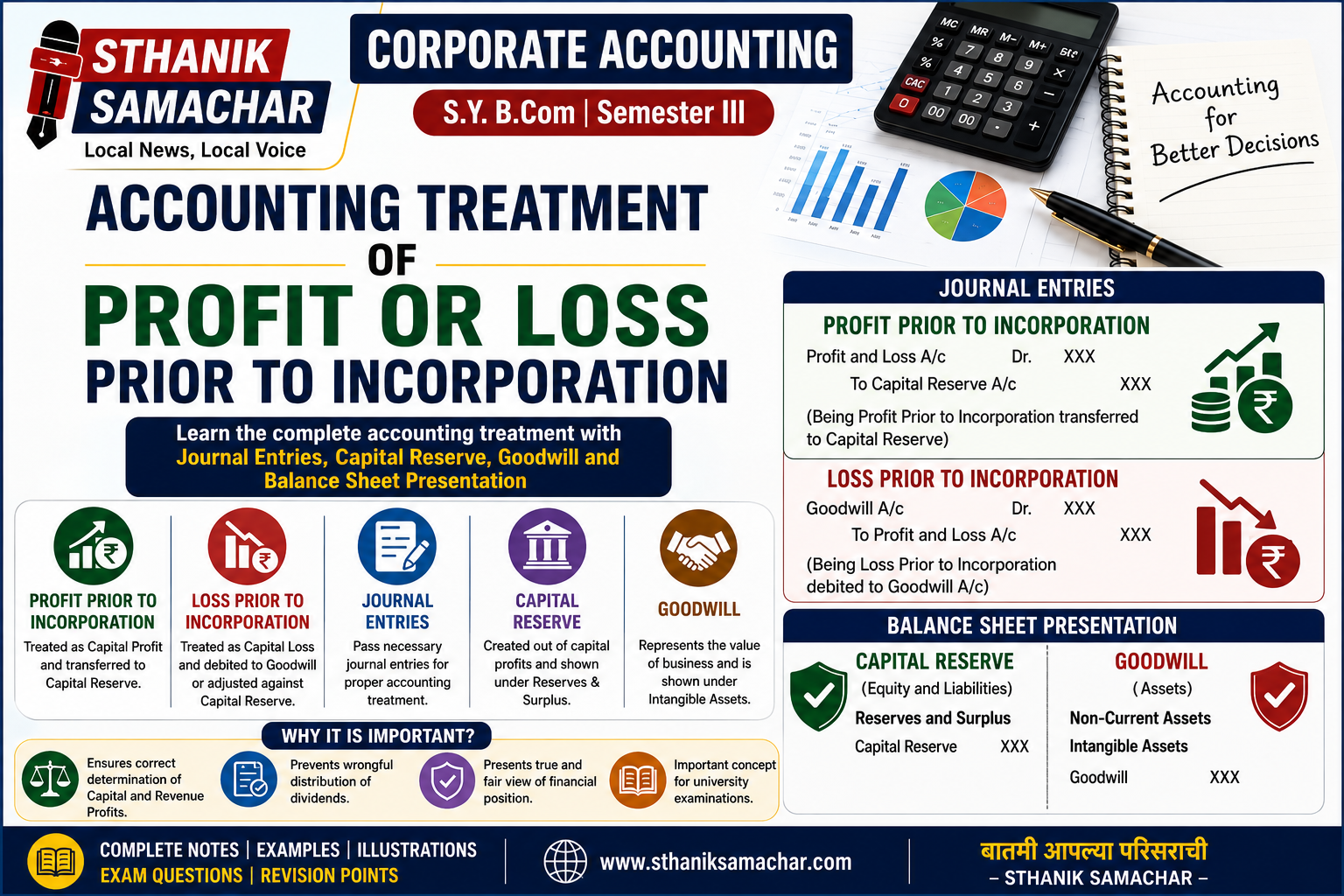
Comprehensive Corporate Accounting notes on Accounting Treatment of Profit or Loss Prior to Incorporation. Learn the treatment of capital profit, capital loss, journal entries, Goodwill, Capital Reserve, and Balance Sheet presentation for S.Y. B.Com Semester III.
Learning Objectives
After studying this article, students will be able to:
- Understand the accounting treatment of Profit Prior to Incorporation and Loss Prior to Incorporation.
- Explain why pre-incorporation profit is treated as a capital profit.
- Record the necessary journal entries for both profit and loss prior to incorporation.
- Understand the role of Capital Reserve and Goodwill in accounting treatment.
- Present Profit or Loss Prior to Incorporation correctly in the Balance Sheet.
- Solve university examination questions related to accounting treatment with confidence.
Introduction
When a company acquires an existing business before its incorporation, it may commence business operations from the date of purchase, although the company becomes a separate legal entity only on the date of incorporation. Consequently, the profit or loss earned during the period between these two dates is known as Profit or Loss Prior to Incorporation.
After preparing the Statement of Apportionment, accountants determine the amount of profit or loss attributable to the pre-incorporation period and the post-incorporation period. Since the company did not legally exist during the pre-incorporation period, the accounting treatment of such profit or loss differs from the treatment of ordinary business profit.
The correct accounting treatment is important because it ensures compliance with accounting principles, prevents incorrect distribution of dividends, and presents a true and fair view of the company’s financial position.
Profit Prior to Incorporation
Meaning
Profit Prior to Incorporation refers to the profit earned by the business from the date of acquisition to the date of incorporation of the company.
This profit does not arise from the company’s own operations because the company was not legally incorporated during this period. Therefore, it is regarded as a Capital Profit rather than a Revenue Profit.
Why is it Treated as Capital Profit?
A company comes into legal existence only after receiving the Certificate of Incorporation from the Registrar of Companies. Before this date:
- The company has no separate legal identity.
- It cannot legally earn business income.
- Shareholders are not entitled to profits earned before incorporation.
- Such profit is considered an adjustment in the purchase consideration paid for acquiring the business.
Hence, the profit is treated as Capital Profit.
Accounting Treatment of Profit Prior to Incorporation
The accepted accounting treatment is as follows:
- It is not transferred to the Profit and Loss Appropriation Account.
- It is not available for dividend distribution.
- It is transferred to Capital Reserve.
- It may also be utilized for writing off Capital Losses, Preliminary Expenses, Goodwill, or other fictitious assets where permitted.
Capital Reserve strengthens the financial position of the company since it represents a capital gain rather than an operating profit.
Journal Entry for Profit Prior to Incorporation
After determining the pre-incorporation profit, the following journal entry is passed:
Journal Entry
| Particulars | Debit (₹) | Credit (₹) |
|---|---|---|
| Profit and Loss Account Dr. | xxx | |
| To Capital Reserve Account | xxx |
Narration:
Being Profit Prior to Incorporation transferred to Capital Reserve.
Capital Reserve
Meaning
Capital Reserve is a reserve created out of capital profits and not from normal trading operations.
It represents gains arising from transactions of a capital nature such as:
- Profit Prior to Incorporation
- Profit on sale of Fixed Assets
- Profit on revaluation (where permitted)
- Securities Premium (subject to legal provisions)
Capital Reserve cannot ordinarily be distributed as dividend because it is not generated through normal business operations.
Uses of Capital Reserve
Capital Reserve may be utilized for:
- Writing off Capital Losses.
- Writing off Preliminary Expenses.
- Writing off Goodwill.
- Writing off Underwriting Commission.
- Issuing Bonus Shares (subject to statutory provisions).
Loss Prior to Incorporation
Meaning
Loss Prior to Incorporation is the loss incurred between the date of acquisition and the date of incorporation.
Since this loss also relates to the period before the company came into existence, it is treated as a Capital Loss.
Accounting Treatment of Loss Prior to Incorporation
Unlike revenue losses, a pre-incorporation loss is not charged against post-incorporation profits directly.
The loss may be treated in one of the following ways:
- Debited to Goodwill Account, or
- Adjusted against Capital Reserve, if sufficient Capital Reserve is available.
The rationale is that the company effectively paid more for the business than the value represented by its net assets.
Journal Entry for Loss Prior to Incorporation
When transferred to Goodwill:
| Particulars | Debit (₹) | Credit (₹) |
|---|---|---|
| Goodwill Account Dr. | xxx | |
| To Profit and Loss Account | xxx |
Narration:
Being Loss Prior to Incorporation transferred to Goodwill.
Alternative Entry
If sufficient Capital Reserve exists:
| Particulars | Debit (₹) | Credit (₹) |
|---|---|---|
| Capital Reserve Account Dr. | xxx | |
| To Profit and Loss Account | xxx |
Narration:
Being Loss Prior to Incorporation adjusted against Capital Reserve.
Goodwill
Meaning
Goodwill is an intangible asset representing the value of a business arising from its reputation, customer loyalty, efficient management, strategic location, and earning capacity.
When a company incurs a Loss Prior to Incorporation, it is often regarded as an additional cost of acquiring the business. Therefore, the loss may be added to Goodwill.
Why is Loss Debited to Goodwill?
The loss represents an additional sacrifice made by the company at the time of acquisition.
Since the benefit of acquiring an established business continues into future years, the loss is capitalized by debiting Goodwill.
Difference Between Capital Reserve and Goodwill
| Basis | Capital Reserve | Goodwill |
|---|---|---|
| Nature | Capital Reserve | Intangible Asset |
| Arises From | Capital Profit | Capital Loss or Purchase Consideration |
| Balance Sheet Position | Equity and Liabilities | Non-Current Assets |
| Dividend | Not distributable | Not applicable |
| Accounting Treatment | Credit Balance | Debit Balance |
| Example | Profit Prior to Incorporation | Loss Prior to Incorporation |
Balance Sheet Presentation
(A) Profit Prior to Incorporation
Shown under:
Equity and Liabilities
Reserves and Surplus
- Capital Reserve
Example:
Equity and Liabilities

Reserves and Surplus

Capital Reserve              ₹2,50,000
General Reserve              ₹4,00,000
Surplus                      ₹6,00,000
(B) Loss Prior to Incorporation
When treated as Goodwill
Shown under:
Non-Current Assets
Intangible Assets
- Goodwill
Example:
Assets

Non-Current Assets

Intangible Assets

Goodwill                    ₹1,75,000
Comprehensive Illustration
ABC Ltd. purchased the business of XYZ Traders on 1 January 2026.
The company was incorporated on 1 April 2026.
After apportionment:
- Profit Prior to Incorporation = ₹3,00,000
- Profit After Incorporation = ₹9,00,000
Accounting Treatment
₹3,00,000 will be transferred to Capital Reserve.
₹9,00,000 will remain as Revenue Profit and will be transferred to the Profit and Loss Appropriation Account.
Alternative Situation
Suppose the pre-incorporation period shows a Loss of ₹1,20,000.
The company will debit:
Goodwill Account
₹1,20,000
Thus, the loss becomes part of the acquisition cost of the business.
Practical Points for University Examinations
Students should remember the following rules:
- Profit Prior to Incorporation = Capital Profit.
- Loss Prior to Incorporation = Capital Loss.
- Capital Profit is transferred to Capital Reserve.
- Capital Loss is generally debited to Goodwill.
- Capital Profit cannot be distributed as dividend.
- Revenue Profit alone is available for dividend distribution.
- Journal entries should include proper narration.
- Balance Sheet presentation should follow the prescribed format.
Common Mistakes Made by Students
Students frequently make the following errors:
- Transferring Pre-Incorporation Profit to General Reserve instead of Capital Reserve.
- Declaring dividend out of Capital Profit.
- Charging Loss Prior to Incorporation to Revenue Profit.
- Ignoring the treatment of Goodwill.
- Showing Capital Reserve under Current Liabilities.
- Passing incorrect journal entries.
Avoiding these mistakes can help secure higher marks in university examinations.
Examination Tips
- Always identify whether the amount relates to the pre-incorporation or post-incorporation period.
- Remember the distinction between Capital Profit and Revenue Profit.
- Write journal entries with narration.
- Learn the Balance Sheet presentation format.
- Use proper accounting terminology such as Capital Reserve, Goodwill, and Capital Loss.
- Revise the accounting treatment through practical illustrations.
Key Points to Remember
- Profit Prior to Incorporation is treated as Capital Profit.
- It is transferred to Capital Reserve.
- It is not available for dividend distribution.
- Loss Prior to Incorporation is treated as Capital Loss.
- It is generally debited to Goodwill or adjusted against Capital Reserve, where appropriate.
- Capital Reserve appears under Reserves and Surplus.
- Goodwill appears under Intangible Assets in the Balance Sheet.
Examination-Oriented Questions
Very Short Answer Questions
- Why is Profit Prior to Incorporation treated as Capital Profit?
- Where is Capital Reserve shown in the Balance Sheet?
- How is Loss Prior to Incorporation treated?
- Can Capital Profit be distributed as dividend?
- What is Goodwill?
Short Answer Questions
- Explain the accounting treatment of Profit Prior to Incorporation.
- Discuss the treatment of Loss Prior to Incorporation.
- Explain the role of Capital Reserve and Goodwill in accounting.
Long Answer Question
Explain the accounting treatment of Profit or Loss Prior to Incorporation. Discuss the journal entries, Capital Reserve, Goodwill, and Balance Sheet presentation with suitable illustrations.
Summary
The Accounting Treatment of Profit or Loss Prior to Incorporation is an important concept in Corporate Accounting because it distinguishes capital items from revenue items. Profit earned before incorporation is regarded as a Capital Profit and is transferred to Capital Reserve, while Loss Prior to Incorporation is treated as a Capital Loss and is generally debited to Goodwill or adjusted against an existing Capital Reserve. These items receive special accounting treatment because they arise before the company becomes a separate legal entity. Proper journal entries, accurate Balance Sheet presentation, and a clear understanding of Capital Reserve and Goodwill are essential for preparing correct financial statements and achieving success in university examinations.

प्रकाश खिलारे हे स्थानिक समाचार डिजिटल मीडिया चे सहसंपादक असून सामाजिक, राजकीय, शैक्षणिक आणि स्थानिक घडामोडींवरील बातम्यांचे वृत्तांकन करतात. जनसामान्यांच्या प्रश्नांना वाचा फोडणे, स्थानिक पातळीवरील महत्त्वाच्या घटनांची अचूक माहिती वाचकांपर्यंत पोहोचवणे आणि निष्पक्ष पत्रकारितेच्या माध्यमातून समाजाशी जोडलेले राहणे हा त्यांच्या लेखनाचा मुख्य उद्देश आहे. डिजिटल पत्रकारितेच्या माध्यमातून ते विविध विषयांवर सखोल आणि प्रभावी बातम्या प्रकाशित करतात. आपण आपल्या परिसरातील बातम्या, माहिती तसेच लेख देण्याकरिता संपर्क करू शकतात…..
मो. 9112225235
Email- prakaashkhilare@gmail.com