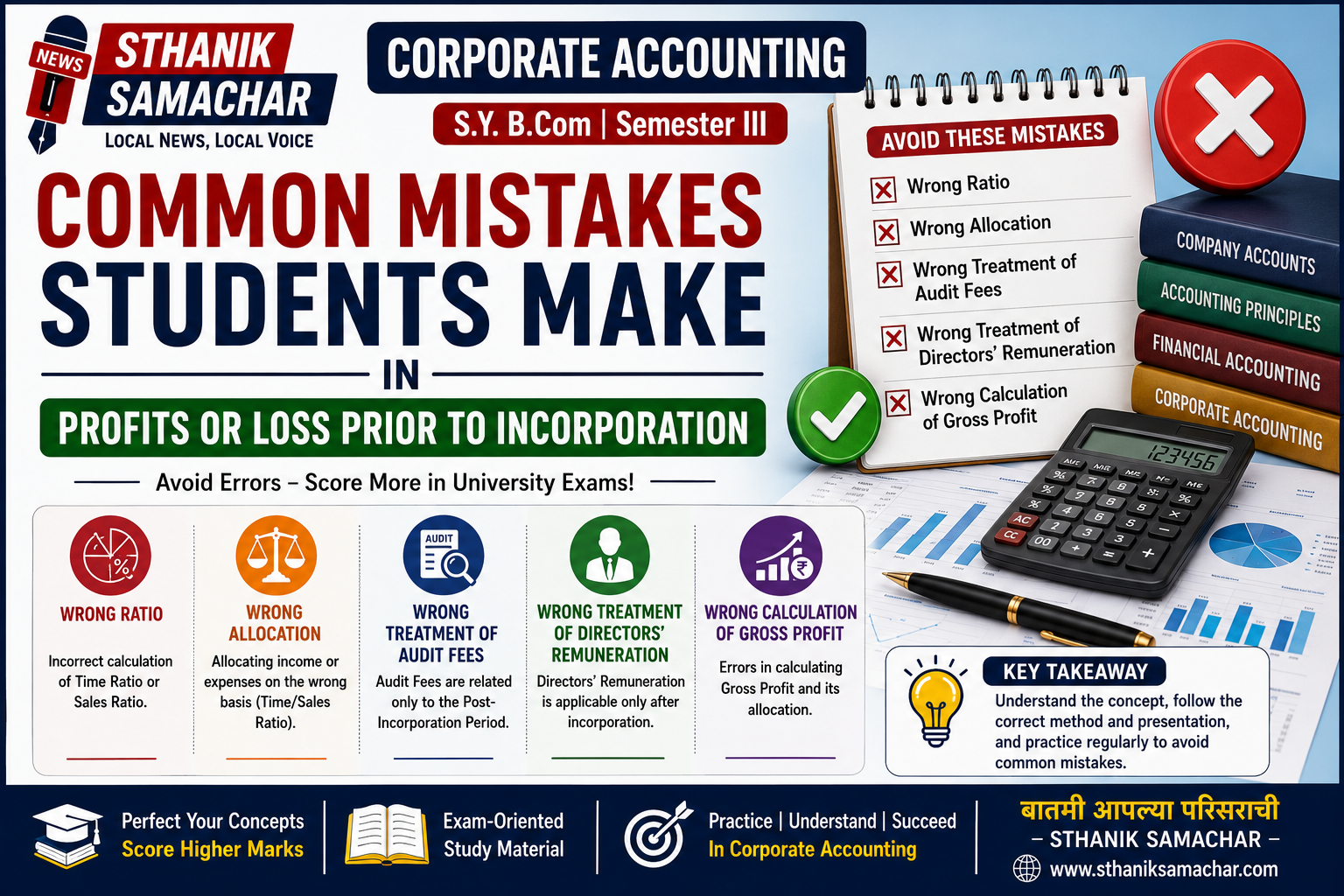
Comprehensive S.Y. B.Com Semester III notes on the Common Mistakes Students Make in Profit or Loss Prior to Incorporation. Improve your exam performance by learning the correct methods of ratio calculation, profit allocation, and accounting treatment.
Learning Objectives
After studying this article, students will be able to:
- Identify the most common mistakes committed in university examinations.
- Understand the correct method of calculating Time Ratio and Sales Ratio.
- Allocate income and expenses accurately.
- Avoid errors in the treatment of Audit Fees, Directors’ Remuneration, and Gross Profit.
- Improve accuracy and score higher marks in Corporate Accounting practical examinations.
Introduction
The chapter Profits or Loss Prior to Incorporation is one of the most scoring topics in Corporate Accounting. However, many students lose marks not because the topic is difficult, but because they make simple calculation and allocation errors.
Most mistakes occur while calculating Time Ratio, Sales Ratio, allocating expenses, or giving incorrect accounting treatment to specific items. Understanding these common errors helps students improve accuracy and avoid unnecessary loss of marks.
This article discusses the most frequently observed mistakes, explains why they occur, and provides practical tips to avoid them.
Mistake 1: Wrong Calculation of Time Ratio
The Mistake
Many students calculate the Time Ratio incorrectly by counting the months inaccurately.
Example
Date of Purchase: 1 January 2026
Date of Incorporation: 1 April 2026
Accounting Year Ends: 31 December 2026
Correct Period:
- Pre-Incorporation = 3 Months
- Post-Incorporation = 9 Months
Correct Time Ratio
3 : 9 = 1 : 3
Wrong Answer
Some students write:
- 4 : 8
- 3 : 8
- 1 : 4
These ratios are incorrect.
Why This Happens
- Incorrect counting of months.
- Confusion about the date of incorporation.
- Ignoring the accounting year.
How to Avoid
- Draw a timeline before solving the problem.
- Count complete months carefully.
- Simplify the ratio before using it.
Mistake 2: Wrong Calculation of Sales Ratio
The Mistake
Students often use the Time Ratio instead of the Sales Ratio for allocating Gross Profit and selling expenses.
Example
Pre-Incorporation Sales = ₹10,00,000
Post-Incorporation Sales = ₹30,00,000
Correct Sales Ratio
10 : 30 = 1 : 3
Some students wrongly use Time Ratio even when separate sales figures are provided.
Why This Happens
- Failure to distinguish between Time Ratio and Sales Ratio.
- Assuming sales occur uniformly throughout the year.
Correct Rule
Whenever separate sales figures are available, always calculate the Sales Ratio.
Mistake 3: Wrong Allocation of Gross Profit
The Mistake
Gross Profit is one of the most commonly misallocated items.
Students frequently allocate Gross Profit using the Time Ratio.
Correct Treatment
Gross Profit depends directly on sales.
Therefore, it should always be allocated on the Sales Ratio.
Example
Gross Profit = ₹12,00,000
Sales Ratio = 1 : 3
Correct Allocation
- Pre = ₹3,00,000
- Post = ₹9,00,000
Wrong Allocation
Using the Time Ratio instead of the Sales Ratio results in an incorrect division of profit.
Examination Tip
Remember: Gross Profit follows Sales, not Time.
Mistake 4: Wrong Allocation of Administrative Expenses
The Mistake
Students often allocate administrative expenses on the Sales Ratio.
Examples include:
- Rent
- Office Salaries
- Insurance
- Office Expenses
- Depreciation
Correct Treatment
Administrative expenses are incurred evenly throughout the accounting period.
Therefore, they should be allocated on the Time Ratio.
Why This Happens
Students assume that all expenses are related to sales.
This assumption is incorrect.
Mistake 5: Wrong Allocation of Selling Expenses
The Mistake
Selling expenses are sometimes allocated on the Time Ratio.
Examples include:
- Advertisement
- Sales Commission
- Carriage Outward
- Discount Allowed
- Bad Debts
- Sales Promotion Expenses
Correct Treatment
These expenses vary according to sales.
Therefore, they must be allocated on the Sales Ratio.
Mistake 6: Wrong Treatment of Audit Fees
The Mistake
Many students divide Audit Fees between both periods.
Correct Treatment
Audit Fees relate to the statutory audit of the company.
Since the company exists only after incorporation, Audit Fees belong entirely to the Post-Incorporation Period.
Wrong Entry
Pre = ₹10,000
Post = ₹30,000
This is incorrect.
Correct Entry
Pre = Nil
Post = Full Amount
Mistake 7: Wrong Treatment of Directors’ Remuneration
The Mistake
Students often apportion Directors’ Remuneration between both periods.
Correct Treatment
Directors are appointed only after incorporation.
Therefore,
Entire Directors’ Remuneration belongs to the Post-Incorporation Period.
Examination Tip
Whenever you see:
- Directors’ Fees
- Directors’ Remuneration
- Managing Director’s Salary
Allocate the entire amount to Post-Incorporation.
Mistake 8: Wrong Treatment of Partners’ Salary
The Mistake
Students allocate Partners’ Salary on the Time Ratio.
Correct Treatment
Partners exist only before incorporation.
Therefore,
Partners’ Salary belongs entirely to the Pre-Incorporation Period.
Mistake 9: Wrong Accounting Treatment of Profit Prior to Incorporation
The Mistake
Students transfer Profit Prior to Incorporation to:
- Profit & Loss Appropriation Account
- General Reserve
Correct Treatment
Profit Prior to Incorporation is:
- Capital Profit
- Transferred to Capital Reserve
- Not available for dividend distribution
Mistake 10: Wrong Accounting Treatment of Loss Prior to Incorporation
The Mistake
Students deduct the loss directly from Revenue Profit.
Correct Treatment
Loss Prior to Incorporation is:
- Capital Loss
- Debited to Goodwill, or
- Adjusted against Capital Reserve, where applicable
Mistake 11: Incorrect Basis of Apportionment
Students frequently confuse the allocation basis.
| Item | Correct Basis |
|---|---|
| Gross Profit | Sales Ratio |
| Advertisement | Sales Ratio |
| Sales Commission | Sales Ratio |
| Bad Debts | Sales Ratio |
| Rent | Time Ratio |
| Salaries | Time Ratio |
| Insurance | Time Ratio |
| Office Expenses | Time Ratio |
| Audit Fees | Post-Incorporation |
| Directors’ Remuneration | Post-Incorporation |
| Partners’ Salary | Pre-Incorporation |
Memorizing this table helps avoid most examination mistakes.
Mistake 12: Arithmetic Errors
Students often lose marks because of:
- Wrong totals
- Incorrect subtraction
- Incorrect allocation amounts
- Errors in balancing statements
Solution
Always:
- Verify calculations.
- Recheck totals.
- Confirm ratios before allocation.
Mistake 13: Ignoring Working Notes
Some students directly prepare the Allocation Statement without showing:
- Time Ratio
- Sales Ratio
- Allocation basis
Most university examiners award marks for correct working notes.
Always show:
- Time Ratio
- Sales Ratio
- Allocation calculations
Mistake 14: Incorrect Balance Sheet Presentation
Students sometimes show:
- Capital Reserve under Current Liabilities.
- Goodwill under Current Assets.
Correct Presentation
Capital Reserve
→ Equity and Liabilities
→ Reserves and Surplus
Goodwill
→ Non-Current Assets
→ Intangible Assets
Summary Table of Common Mistakes
| Common Mistake | Correct Treatment |
|---|---|
| Wrong Time Ratio | Count months carefully |
| Wrong Sales Ratio | Use actual sales figures |
| Gross Profit on Time Ratio | Allocate on Sales Ratio |
| Administrative Expenses on Sales Ratio | Allocate on Time Ratio |
| Audit Fees apportioned | Entirely Post-Incorporation |
| Directors’ Remuneration apportioned | Entirely Post-Incorporation |
| Partners’ Salary apportioned | Entirely Pre-Incorporation |
| Profit transferred to General Reserve | Transfer to Capital Reserve |
| Loss deducted from Revenue Profit | Debit to Goodwill or adjust against Capital Reserve |
| Incorrect Balance Sheet | Follow prescribed presentation |
Practical Tips to Avoid Mistakes
- Read the question carefully before solving.
- Draw a timeline to calculate the Time Ratio.
- Calculate the Sales Ratio separately.
- Identify the basis of allocation for every item.
- Prepare working notes before the Allocation Statement.
- Use a tabular format for better presentation.
- Verify all calculations.
- Revise journal entries before the examination.
- Practice at least 10 numerical problems.
- Leave five minutes at the end to recheck the solution.
Examination-Oriented Questions
Very Short Answer Questions
- Why is Gross Profit allocated on the Sales Ratio?
- Why are Audit Fees allocated entirely to the Post-Incorporation Period?
- Which expenses are allocated on the Time Ratio?
- Where is Capital Reserve shown in the Balance Sheet?
- Why is Partners’ Salary allocated to the Pre-Incorporation Period?
Short Answer Questions
- Explain the common mistakes students make while calculating Profit Prior to Incorporation.
- Discuss the correct treatment of Audit Fees and Directors’ Remuneration.
- Explain why Gross Profit is allocated on the Sales Ratio.
Long Answer Question
Discuss the common mistakes committed by students while solving problems on Profits or Loss Prior to Incorporation. Explain the correct accounting treatment and suggest measures to avoid these mistakes.
Key Points to Remember
- Calculate the Time Ratio correctly before allocation.
- Use the Sales Ratio for Gross Profit and selling expenses.
- Allocate administrative expenses using the Time Ratio.
- Audit Fees and Directors’ Remuneration belong entirely to the Post-Incorporation Period.
- Partners’ Salary belongs entirely to the Pre-Incorporation Period.
- Transfer Profit Prior to Incorporation to Capital Reserve.
- Treat Loss Prior to Incorporation as Capital Loss.
- Always prepare proper working notes and verify calculations.
Summary
Students often lose marks in Profits or Loss Prior to Incorporation because of avoidable mistakes such as incorrect ratio calculations, wrong allocation of income and expenses, improper accounting treatment of Audit Fees, Directors’ Remuneration, and Partners’ Salary, and errors in determining Gross Profit. Most of these mistakes arise from misunderstanding the basis of apportionment or failing to prepare proper working notes. By carefully calculating the Time Ratio and Sales Ratio, applying the correct basis of allocation, following prescribed accounting treatments, and reviewing calculations before submission, students can significantly improve accuracy and score excellent marks in Corporate Accounting examinations.

प्रकाश खिलारे हे स्थानिक समाचार डिजिटल मीडिया चे सहसंपादक असून सामाजिक, राजकीय, शैक्षणिक आणि स्थानिक घडामोडींवरील बातम्यांचे वृत्तांकन करतात. जनसामान्यांच्या प्रश्नांना वाचा फोडणे, स्थानिक पातळीवरील महत्त्वाच्या घटनांची अचूक माहिती वाचकांपर्यंत पोहोचवणे आणि निष्पक्ष पत्रकारितेच्या माध्यमातून समाजाशी जोडलेले राहणे हा त्यांच्या लेखनाचा मुख्य उद्देश आहे. डिजिटल पत्रकारितेच्या माध्यमातून ते विविध विषयांवर सखोल आणि प्रभावी बातम्या प्रकाशित करतात. आपण आपल्या परिसरातील बातम्या, माहिती तसेच लेख देण्याकरिता संपर्क करू शकतात…..
मो. 9112225235
Email- prakaashkhilare@gmail.com