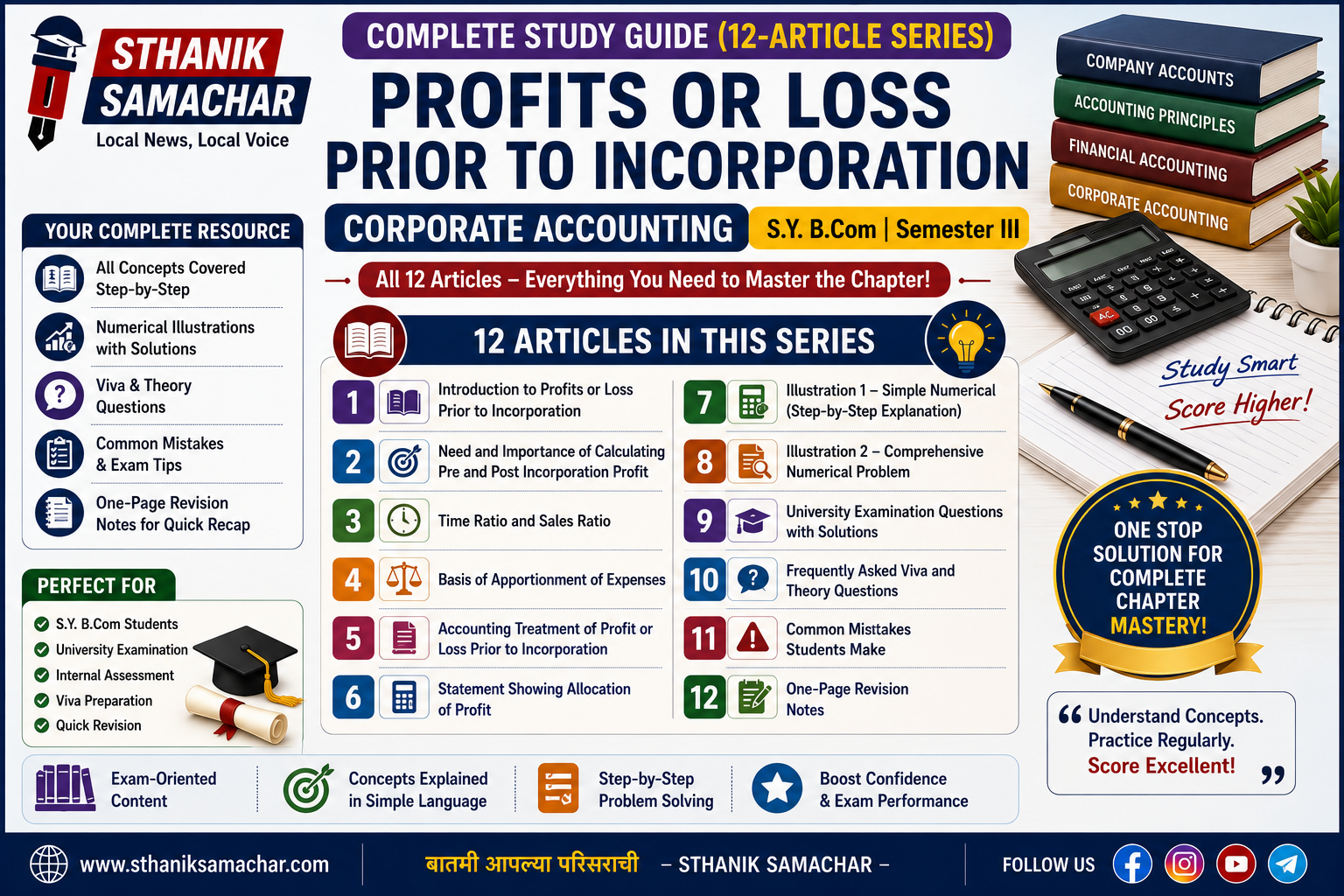
Comprehensive Corporate Accounting notes on the Basis of Apportionment of Expenses. Explore the allocation of pre-incorporation and post-incorporation income and expenses using Time Ratio, Sales Ratio, and Specific Allocation for university examination preparation.
Learning Objectives
After studying this article, students will be able to:
- Understand the meaning of apportionment of expenses.
- Explain the necessity of apportioning expenses between pre-incorporation and post-incorporation periods.
- Identify the appropriate basis for allocating different incomes and expenses.
- Apply Time Ratio, Sales Ratio, and Specific Allocation correctly in practical problems.
- Solve university examination questions related to the apportionment of expenses with confidence.
Introduction
When a company acquires an existing business before its incorporation, the Profit and Loss Account prepared at the end of the accounting year includes incomes and expenses relating to both the pre-incorporation period and the post-incorporation period. Since the company legally comes into existence only on the date of incorporation, it becomes necessary to divide the total profit or loss into two separate periods.
This process of distributing incomes and expenses between the pre-incorporation and post-incorporation periods is known as Apportionment of Expenses.
The allocation should be fair, logical, and based on the nature of each income or expense. Therefore, accountants use different bases such as Time Ratio, Sales Ratio, and Specific Allocation for apportioning various items.
Meaning of Apportionment of Expenses
Apportionment of expenses refers to the systematic distribution of common incomes and expenses between the pre-incorporation period and the post-incorporation period on an appropriate basis.
The objective is to determine:
- Capital Profit or Capital Loss (Pre-Incorporation)
- Revenue Profit or Revenue Loss (Post-Incorporation)
Incorrect allocation may lead to incorrect profit determination and improper accounting treatment.
Basis of Apportionment
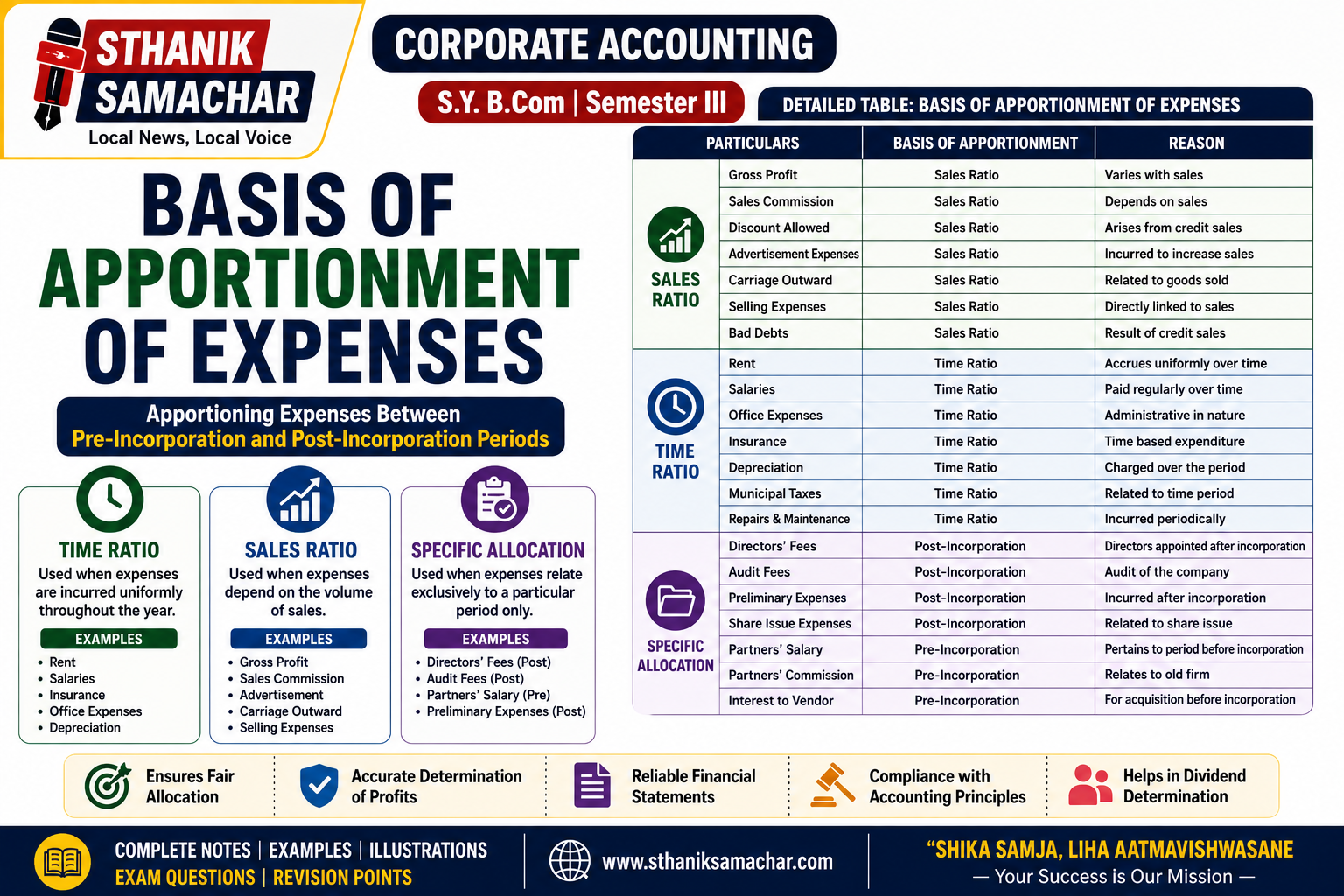
Generally, incomes and expenses are allocated on one of the following bases:
1. Time Ratio
Used when the expense is incurred uniformly throughout the accounting period.
2. Sales Ratio
Used when the income or expense depends upon the volume of sales.
3. Specific Allocation
Used when an item clearly relates only to either the pre-incorporation period or the post-incorporation period.
Detailed Table Showing Basis of Apportionment
| Particulars | Basis of Apportionment | Reason |
|---|---|---|
| Gross Profit | Sales Ratio | Gross profit varies directly with sales. |
| Sales | Actual Sales | Sales are divided according to actual figures. |
| Sales Commission | Sales Ratio | Depends upon sales volume. |
| Commission on Sales | Sales Ratio | Related directly to sales. |
| Discount Allowed | Sales Ratio | Arises from credit sales. |
| Discount Received | Sales Ratio (where related to purchases/sales) | Linked with trading transactions. |
| Carriage Outward | Sales Ratio | Selling expense incurred on sales. |
| Freight Outward | Sales Ratio | Depends upon goods sold. |
| Advertisement Expenses | Sales Ratio | Incurred to increase sales. |
| Selling Expenses | Sales Ratio | Directly related to sales activity. |
| Bad Debts | Sales Ratio | Result from credit sales. |
| Salesmen’s Salary | Sales Ratio | Linked with sales performance. |
| Delivery Expenses | Sales Ratio | Depends upon goods delivered. |
| Packing Expenses (Sales) | Sales Ratio | Incurred for dispatch of goods sold. |
| Collection Charges | Sales Ratio | Connected with realization of sales. |
| Rent | Time Ratio | Accrues uniformly throughout the year. |
| Office Salaries | Time Ratio | Paid regularly over time. |
| Office Expenses | Time Ratio | Administrative expenses occur evenly. |
| Insurance | Time Ratio | Time-based expenditure. |
| Depreciation | Time Ratio | Charged according to usage over time. |
| Municipal Taxes | Time Ratio | Levied for a specific period. |
| Printing and Stationery | Time Ratio | Administrative expense. |
| Telephone Expenses | Time Ratio | Incurred continuously. |
| Electricity Charges | Time Ratio | Normally distributed over time. |
| Repairs and Maintenance | Time Ratio | Periodical administrative expense. |
| Office Maintenance Expenses | Time Ratio | Time-based expenditure. |
| Audit Fees | Post-Incorporation (Specific Allocation) | Audit relates to the company after incorporation. |
| Directors’ Fees | Post-Incorporation (Specific Allocation) | Directors are appointed after incorporation. |
| Managing Director’s Remuneration | Post-Incorporation (Specific Allocation) | Paid only after company formation. |
| Company Formation Expenses | Post-Incorporation (Specific Allocation) | Incurred after incorporation. |
| Preliminary Expenses | Post-Incorporation (Specific Allocation) | Company-related expenditure. |
| Debenture Interest | Post-Incorporation (Specific Allocation) | Debentures issued after incorporation. |
| Interest on Company’s Loan | Post-Incorporation (Specific Allocation) | Company borrows after incorporation. |
| Share Issue Expenses | Post-Incorporation (Specific Allocation) | Related to issue of shares. |
| Partners’ Salary | Pre-Incorporation (Specific Allocation) | Pertains to the business before company formation. |
| Partners’ Commission | Pre-Incorporation (Specific Allocation) | Paid before incorporation. |
| Interest on Purchase Consideration Payable to Vendor | Pre-Incorporation (Specific Allocation) | Relates to acquisition period before incorporation. |
| Vendor’s Compensation | Pre-Incorporation (Specific Allocation) | Pertains to business acquisition. |
| Income Tax | Post-Incorporation (Specific Allocation) | Company tax liability arises after incorporation. |
| Dividend Received (Investment Income) | Specific Allocation | Allocated according to the period in which it is earned. |
| Interest Received | Specific Allocation | Allocated to the period to which it belongs. |
| Rent Received | Specific Allocation | Allocated according to actual receipt period. |
Explanation of the Three Bases
1. Time Ratio
Time Ratio is used when an expense is incurred evenly throughout the accounting period without any relation to the volume of business.
Examples include:
- Office Rent
- Salaries
- Insurance
- Depreciation
- Telephone Charges
- Electricity Expenses
- Office Expenses
These expenses are distributed according to the duration of each accounting period.
2. Sales Ratio
Sales Ratio is applied to incomes and expenses that fluctuate according to the level of sales.
Examples include:
- Gross Profit
- Sales Commission
- Advertisement
- Carriage Outward
- Discount Allowed
- Selling Expenses
- Bad Debts
These items increase or decrease in proportion to sales.
3. Specific Allocation
Certain expenses belong exclusively to either the pre-incorporation period or the post-incorporation period.
For example:
Pre-Incorporation Only
- Partners’ Salary
- Partners’ Commission
- Interest payable to Vendor
Post-Incorporation Only
- Directors’ Fees
- Audit Fees
- Preliminary Expenses
- Share Issue Expenses
- Debenture Interest
These expenses are not apportioned. They are charged wholly to the relevant period.
Practical Illustration
Suppose:
- Rent = ₹1,20,000
- Gross Profit = ₹12,00,000
- Audit Fees = ₹30,000
- Partners’ Salary = ₹60,000
The basis of allocation will be:
| Item | Basis |
|---|---|
| Rent | Time Ratio |
| Gross Profit | Sales Ratio |
| Audit Fees | Post-Incorporation |
| Partners’ Salary | Pre-Incorporation |
Importance of Correct Apportionment
Correct apportionment is essential because it:
- Determines Capital Profit accurately.
- Determines Revenue Profit correctly.
- Ensures proper accounting treatment.
- Prevents incorrect declaration of dividends.
- Facilitates preparation of reliable financial statements.
- Helps auditors verify financial records.
- Ensures compliance with accounting principles and company law.
Common Mistakes Made by Students
Students frequently make the following mistakes:
- Allocating Gross Profit on Time Ratio instead of Sales Ratio.
- Allocating Rent on Sales Ratio.
- Charging Directors’ Fees to both periods.
- Forgetting that Partners’ Salary belongs only to the pre-incorporation period.
- Apportioning Preliminary Expenses instead of charging them entirely to the post-incorporation period.
- Ignoring specific allocation items.
Understanding the nature of each expense helps avoid these errors.
Examination Tips
- First identify whether an item is related to time, sales, or a specific period.
- Prepare the Time Ratio and Sales Ratio before allocating expenses.
- Learn the commonly asked items and their basis of apportionment.
- Remember that Gross Profit is almost always apportioned on Sales Ratio.
- Audit Fees, Directors’ Fees, and Preliminary Expenses generally belong to the Post-Incorporation Period.
- Partners’ Salary and Partners’ Commission belong to the Pre-Incorporation Period.
Key Points to Remember
- Expenses are apportioned using Time Ratio, Sales Ratio, or Specific Allocation.
- Administrative expenses generally follow Time Ratio.
- Selling and trading-related expenses generally follow Sales Ratio.
- Company-related expenses after incorporation are charged wholly to the Post-Incorporation Period.
- Partners’ remuneration belongs entirely to the Pre-Incorporation Period.
- Correct apportionment ensures accurate determination of Capital Profit and Revenue Profit.
Examination-Oriented Questions
Very Short Answer Questions
- What is meant by apportionment of expenses?
- Name the three bases of apportionment.
- On what basis is Gross Profit apportioned?
- Why are Directors’ Fees not apportioned?
- Which expenses are allocated on Time Ratio?
Short Answer Questions
- Explain the basis of apportionment of expenses.
- Distinguish between Time Ratio, Sales Ratio, and Specific Allocation.
- Explain the treatment of Partners’ Salary and Audit Fees.
Long Answer Question
Explain the basis of apportionment of expenses between pre-incorporation and post-incorporation periods. Discuss the allocation of various incomes and expenses with suitable examples.
Summary
The Basis of Apportionment of Expenses is a fundamental concept in Corporate Accounting that ensures the fair distribution of income and expenses between the pre-incorporation and post-incorporation periods. Depending on their nature, items are allocated using Time Ratio, Sales Ratio, or Specific Allocation. Administrative expenses such as rent and salaries are generally apportioned on a Time Ratio, while trading and selling-related items such as Gross Profit and Advertisement Expenses are allocated on a Sales Ratio. Certain expenses, including Directors’ Fees, Audit Fees, Preliminary Expenses, and Partners’ Salary, are charged exclusively to one period through Specific Allocation. A clear understanding of these principles enables students to prepare accurate financial statements and solve university examination problems effectively.

प्रकाश खिलारे हे स्थानिक समाचार डिजिटल मीडिया चे सहसंपादक असून सामाजिक, राजकीय, शैक्षणिक आणि स्थानिक घडामोडींवरील बातम्यांचे वृत्तांकन करतात. जनसामान्यांच्या प्रश्नांना वाचा फोडणे, स्थानिक पातळीवरील महत्त्वाच्या घटनांची अचूक माहिती वाचकांपर्यंत पोहोचवणे आणि निष्पक्ष पत्रकारितेच्या माध्यमातून समाजाशी जोडलेले राहणे हा त्यांच्या लेखनाचा मुख्य उद्देश आहे. डिजिटल पत्रकारितेच्या माध्यमातून ते विविध विषयांवर सखोल आणि प्रभावी बातम्या प्रकाशित करतात. आपण आपल्या परिसरातील बातम्या, माहिती तसेच लेख देण्याकरिता संपर्क करू शकतात…..
मो. 9112225235
Email- prakaashkhilare@gmail.com