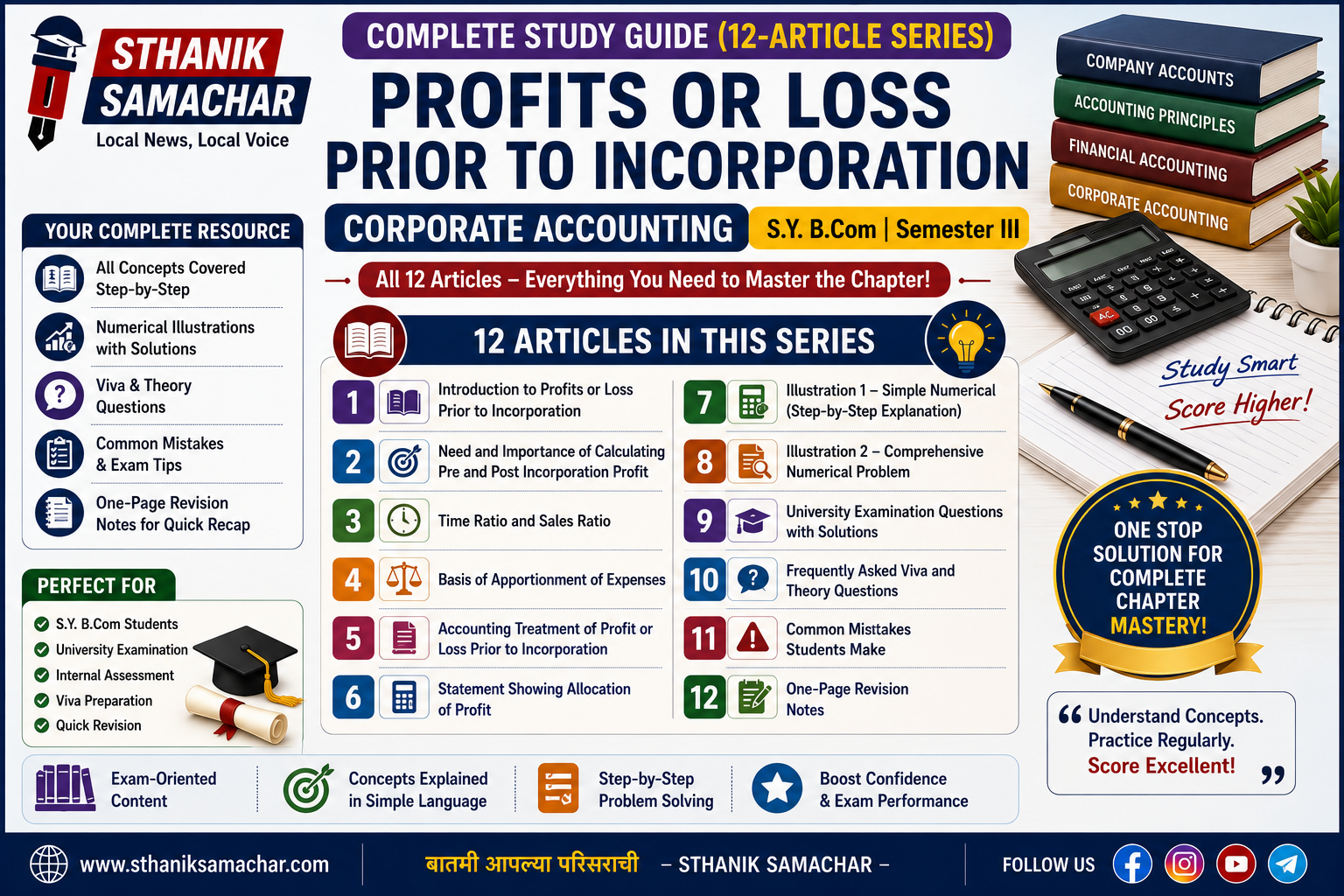
Comprehensive Corporate Accounting notes on Profits or Loss Prior to Incorporation for B.Com students. Learn concepts, illustrations, examination points, and the difference between capital and revenue profit.
Profits or Loss Prior to Incorporation (Pre-Incorporation Profit or Loss)
Learning Objectives
After studying this article, students will be able to:
- Understand the meaning of Profit or Loss Prior to Incorporation.
- Differentiate between the Date of Purchase and the Date of Incorporation.
- Explain why pre-incorporation profit is treated as a capital profit.
- Distinguish between capital profit and revenue profit.
- Identify the accounting treatment of pre-incorporation profit or loss.
Introduction
A company may acquire an existing business before it is legally incorporated. In such cases, the business may continue to operate from the date of purchase, even though the company comes into legal existence only on a later date.
The profit or loss earned during the period between the date of purchase and the date of incorporation is known as Profit or Loss Prior to Incorporation (also called Pre-Incorporation Profit or Loss).
Since the company was not legally in existence during this period, such profit is not considered an ordinary business profit. Instead, it is treated as a capital profit.
Meaning
Profit Prior to Incorporation refers to the profit earned by a business from the date on which it is acquired by a company up to the date on which the company is legally incorporated.
Similarly,
Loss Prior to Incorporation refers to the loss incurred during the period between the date of acquisition of the business and the date of incorporation of the company.
Definition
Profit Prior to Incorporation is the profit earned during the period between the date of acquisition (purchase) of a business and the date of incorporation of the purchasing company.
It is a capital profit because it arises before the company legally comes into existence.
Why Does Pre-Incorporation Profit Arise?
A company is formed through a legal process that requires time. However, promoters often purchase an existing business before the company is officially incorporated.
The business operations continue without interruption. Consequently, profits or losses are earned during this interim period.
Therefore, the total profit for the accounting year must be divided into:
- Pre-Incorporation Period
- Post-Incorporation Period
This division ensures the correct accounting treatment of profits and expenses.
Important Dates
There are two important dates involved:
1. Date of Purchase (Date of Acquisition)
This is the date on which the promoters purchase the business on behalf of the proposed company.
Business operations are considered to commence from this date.
Example
Business purchased on 1 January 2026
2. Date of Incorporation
This is the date on which the Registrar of Companies issues the Certificate of Incorporation.
The company becomes a separate legal entity from this date.
Example
Company incorporated on 1 April 2026
Illustration
Suppose:
- Date of Purchase: 1 January 2026
- Date of Incorporation: 1 April 2026
- Financial Year Ends: 31 December 2026
Pre-Incorporation Period
1 January 2026 to 31 March 2026
Post-Incorporation Period
1 April 2026 to 31 December 2026
If the company earns a total profit during the year, the profit must be apportioned between these two periods.
Why is Pre-Incorporation Profit Treated as Capital Profit?
A company cannot earn revenue before it legally exists.
Therefore:
- The company was not legally formed.
- Shareholders were not members of the company.
- No dividend can be declared from such profit.
- The profit represents an adjustment in the purchase price of the business.
Hence, it is treated as Capital Profit.
Normally, such profit is transferred to Capital Reserve.
Why is Post-Incorporation Profit Treated as Revenue Profit?
Once the company is legally incorporated:
- It becomes a separate legal entity.
- It starts carrying on business in its own name.
- Profits earned thereafter are normal operating profits.
Therefore, post-incorporation profit is treated as Revenue Profit.
It may be:
- Transferred to the Profit and Loss Account.
- Used for payment of dividends.
- Retained as reserves.
Difference Between Capital Profit and Revenue Profit
| Basis | Capital Profit | Revenue Profit |
|---|---|---|
| Meaning | Profit earned before incorporation | Profit earned after incorporation |
| Nature | Capital | Revenue |
| Source | Acquisition of business | Normal business operations |
| Dividend | Cannot be distributed | Can be distributed (subject to law) |
| Transfer | Capital Reserve | Profit & Loss Appropriation Account / General Reserve |
Need for Apportionment
The total profit shown by the Profit and Loss Account relates to the entire accounting year.
Since part of the year falls before incorporation and the remaining period falls after incorporation, it becomes necessary to divide:
- Gross Profit
- Expenses
- Net Profit
between the two periods using appropriate bases such as:
- Time Ratio
- Sales Ratio
- Specific Allocation
These methods will be discussed in the next articles.
Example
ABC Ltd. purchased the business of XYZ Traders on 1 January 2026.
The company was incorporated on 1 April 2026.
The accounting year ended on 31 December 2026.
During the year, the business earned a net profit of ₹12,00,000.
The profit must first be divided into:
- Profit Prior to Incorporation
- Profit After Incorporation
Only the post-incorporation profit is available for dividend distribution.
Key Points to Remember
- Profit earned before incorporation is called Pre-Incorporation Profit.
- Loss incurred before incorporation is called Pre-Incorporation Loss.
- It arises when a company acquires an existing business before incorporation.
- It is treated as a Capital Profit.
- It is generally transferred to Capital Reserve.
- It cannot be distributed as dividend.
- Profit earned after incorporation is treated as Revenue Profit.
Examination-Oriented Questions
Very Short Answer Questions
- What is Profit Prior to Incorporation?
- What is meant by Date of Purchase?
- What is Date of Incorporation?
- Why is pre-incorporation profit treated as capital profit?
- Where is pre-incorporation profit transferred?
Short Answer Questions
- Explain the meaning of Profit Prior to Incorporation.
- Distinguish between Capital Profit and Revenue Profit.
- Explain why Profit Prior to Incorporation cannot be distributed as dividend.
Long Answer Question
Explain the concept of Profits or Loss Prior to Incorporation. Why is pre-incorporation profit treated as capital profit? Explain with a suitable illustration.
Summary
Profit or Loss Prior to Incorporation is an important concept in Corporate Accounting. It arises when a company acquires an existing business before becoming legally incorporated. Since the company does not legally exist during the pre-incorporation period, any profit earned is regarded as a capital profit and is transferred to Capital Reserve. In contrast, profits earned after incorporation are revenue profits, which may be distributed as dividends subject to legal provisions. Understanding the distinction between these two periods forms the foundation for learning the methods of profit allocation, including Time Ratio, Sales Ratio, and the apportionment of expenses, which are covered in subsequent articles.

प्रकाश खिलारे हे स्थानिक समाचार डिजिटल मीडिया चे सहसंपादक असून सामाजिक, राजकीय, शैक्षणिक आणि स्थानिक घडामोडींवरील बातम्यांचे वृत्तांकन करतात. जनसामान्यांच्या प्रश्नांना वाचा फोडणे, स्थानिक पातळीवरील महत्त्वाच्या घटनांची अचूक माहिती वाचकांपर्यंत पोहोचवणे आणि निष्पक्ष पत्रकारितेच्या माध्यमातून समाजाशी जोडलेले राहणे हा त्यांच्या लेखनाचा मुख्य उद्देश आहे. डिजिटल पत्रकारितेच्या माध्यमातून ते विविध विषयांवर सखोल आणि प्रभावी बातम्या प्रकाशित करतात. आपण आपल्या परिसरातील बातम्या, माहिती तसेच लेख देण्याकरिता संपर्क करू शकतात…..
मो. 9112225235
Email- prakaashkhilare@gmail.com