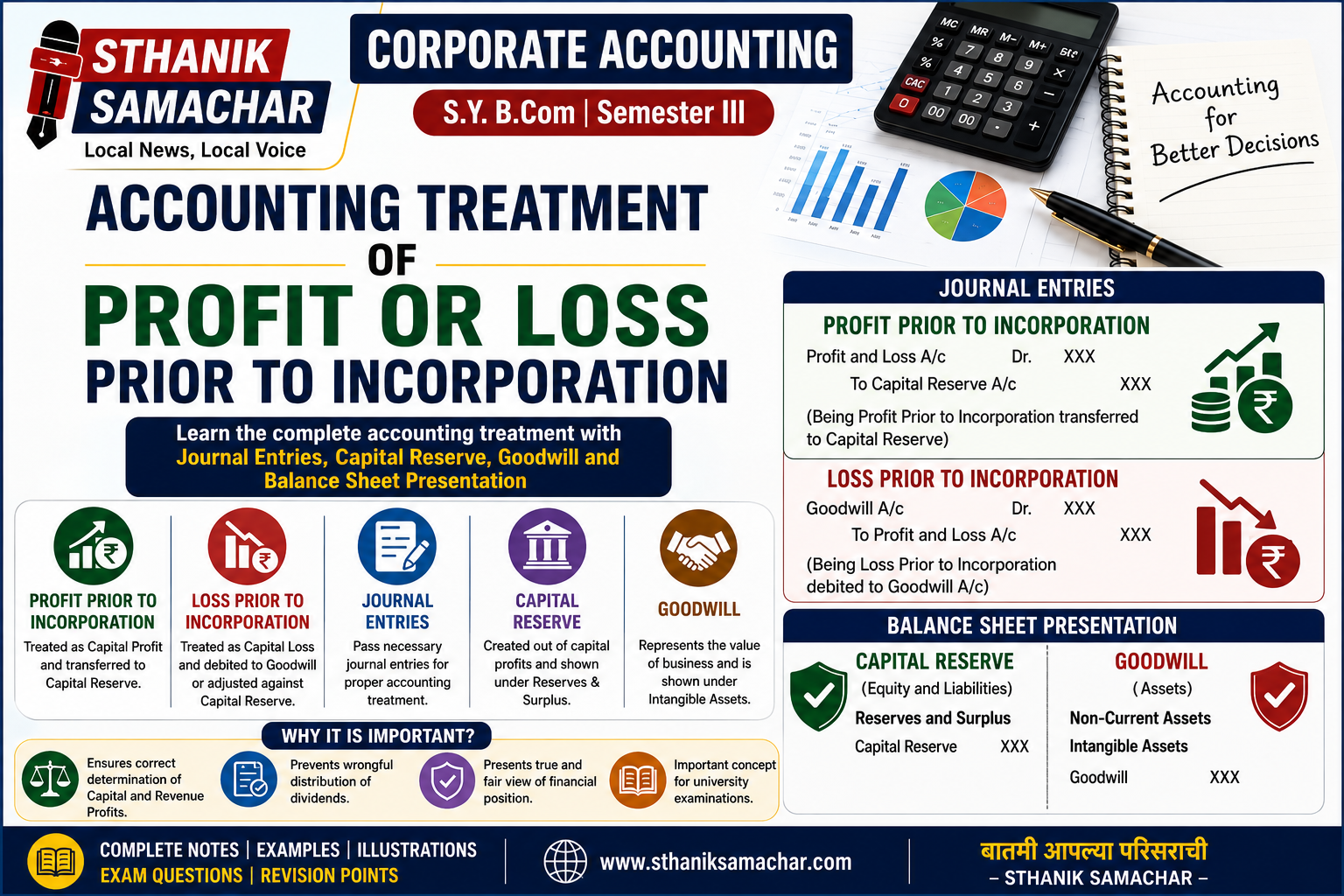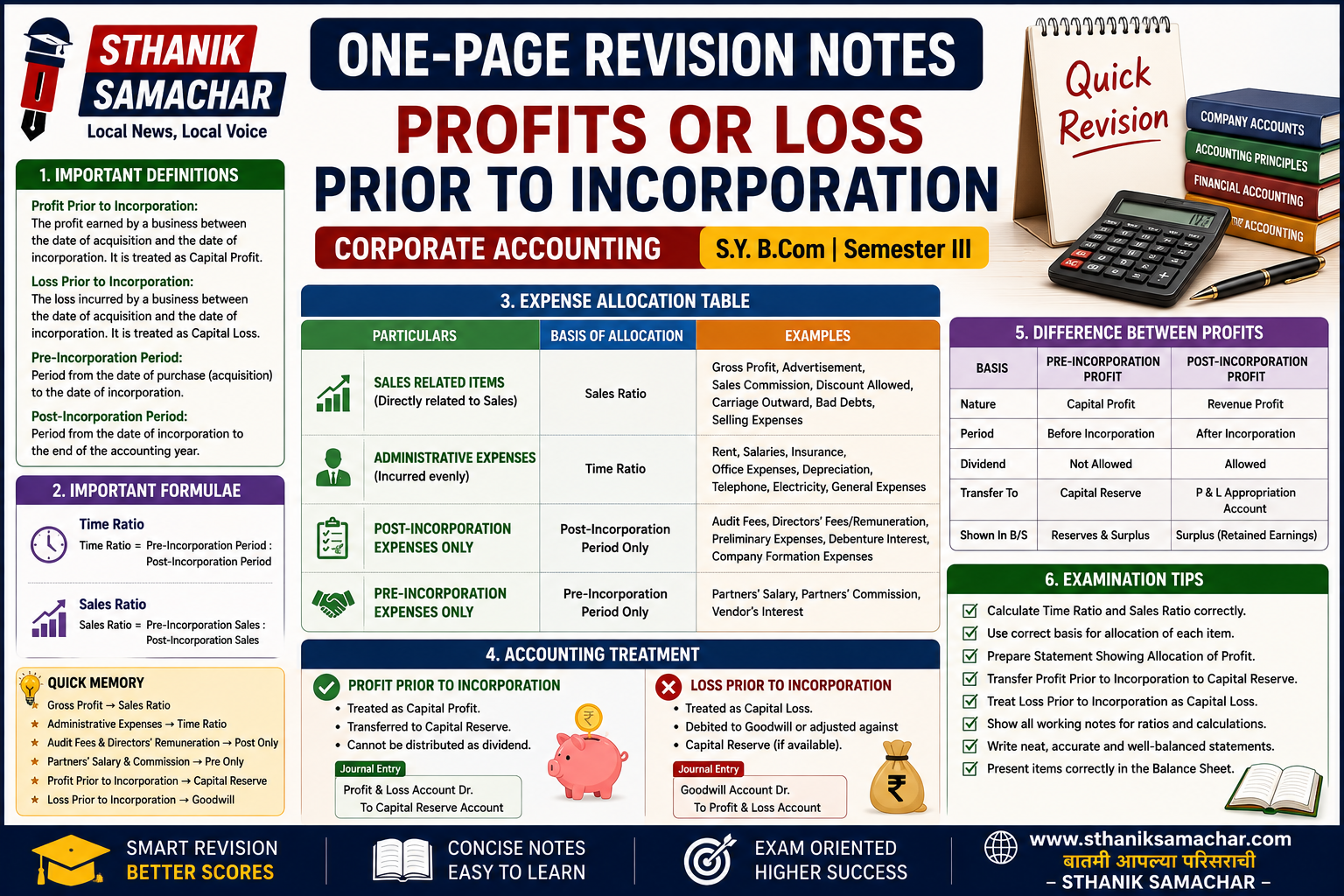
Understand the fundamentals of Equity Shares and Share Capital with this comprehensive Corporate Accounting article.
Introduction
The Issue of Equity Shares is an important topic in Corporate Accounting for S.Y. B.Com Semester III students. Every company requires adequate finance for establishing its business, purchasing assets, meeting working capital requirements, expanding operations, and carrying out its long-term business activities. One of the major sources of long-term finance available to a company is share capital. A company can raise funds by issuing shares to investors, and equity shares constitute an important part of the company’s share capital. Equity shares are generally considered ownership capital because the holders of these shares participate in the ownership and decision-making process of the company through voting rights. The return on equity shares is generally not fixed and depends upon the profitability of the company and the decision regarding distribution of profits. Therefore, understanding the meaning, characteristics, importance, and accounting aspects of equity shares is essential for students studying Corporate Accounting.
Meaning of Shares
A share represents a unit into which the share capital of a company is divided. In simple words, the total share capital of a company is divided into a number of smaller units known as shares. Each share normally carries a specified face value. For example, if a company has a share capital of ₹10,00,000 divided into 1,00,000 shares of ₹10 each, each ₹10 unit represents one share of the company. The person who purchases or holds these shares is known as a shareholder. The ownership interest of shareholders in the company is represented through the number and class of shares held by them. Shares therefore provide a mechanism through which a company can collect capital from a large number of investors.
The basic relationship can be expressed as Share Capital = Number of Shares × Face Value per Share. For example, if a company issues 50,000 shares of ₹10 each, its share capital represented by those shares will be ₹5,00,000. The concept of shares is fundamental to company accounting because transactions relating to application, allotment, calls, forfeiture, and reissue are recorded with reference to the shares issued by the company.
Meaning of Equity Shares
Equity Shares are shares that do not carry a preferential right regarding payment of dividend or repayment of capital over other classes of shares. Equity shareholders are generally regarded as the risk-bearing owners of the company. Their return is not normally fixed and depends upon the profits available for distribution and the decision of the company to declare dividends. If the company earns higher profits and declares a higher dividend, equity shareholders may receive a better return. On the other hand, if the company earns inadequate profits, the dividend may be reduced or may not be declared.
Equity shareholders generally enjoy voting rights and can participate in important decisions of the company. Their voting rights provide them with an opportunity to participate in matters such as the appointment of directors and other important corporate decisions, subject to the applicable provisions of company law. Equity shareholders also have a residual interest in the assets of the company. This means that, upon winding up, their claims are satisfied after the claims of creditors and other preferential claims have been settled according to law.
Importance of Share Capital
Share Capital is an important source of finance for a company. A business requires capital not only at the time of its formation but also throughout its life for expansion, modernization, working capital, acquisition of assets, repayment or restructuring of certain liabilities, and other legitimate business purposes. Share capital enables a company to collect funds from investors and use those funds for its business activities.
Share capital is particularly important because it provides a relatively permanent source of finance. Unlike ordinary borrowings, equity share capital does not normally carry a fixed maturity date. The company is also not generally required to pay a fixed rate of return to equity shareholders every year. Dividend depends on profits and the company’s decision to distribute them, subject to applicable legal provisions. Thus, equity share capital can provide financial stability and strengthen the company’s capital structure.
A strong equity capital base may also improve the company’s ability to obtain additional finance from other sources. Financial institutions, lenders, suppliers, and other stakeholders may consider the company’s capital structure when assessing its financial strength. Therefore, share capital plays an important role in supporting the company’s long-term financial position.
Role of Equity Shares in Company Financing
Equity shares play a significant role in financing the activities of a company. When a company issues equity shares, it raises funds from investors in exchange for ownership interests. These funds may be used for establishing new projects, purchasing land and buildings, acquiring machinery and equipment, developing technology, opening new branches, increasing production capacity, entering new markets, and meeting working capital requirements.
Equity financing also helps a company reduce excessive dependence on borrowed funds. Borrowings generally involve interest obligations and repayment requirements. Equity shares, on the other hand, do not normally require the company to pay a fixed dividend. This provides greater flexibility, particularly when the company’s profitability fluctuates. However, issuing additional equity shares may dilute the ownership percentage and voting influence of existing shareholders.
Equity shares therefore represent an important form of risk-bearing finance. The investors provide capital with the expectation of receiving dividends and benefiting from possible appreciation in the value of their investment. At the same time, they bear the business risk associated with the company’s performance. The success of the company can therefore directly influence the return received by equity shareholders.
Basic Terminology Related to Issue of Equity Shares
Several basic terms are important for understanding the issue of equity shares. Share Capital refers to the capital raised by a company through the issue of shares. Face Value, also known as nominal value, is the value assigned to each share in the company’s capital structure, such as ₹1, ₹2, ₹5, or ₹10 per share. Issue Price is the price at which the company offers its shares to investors. When the issue price is equal to the face value, the shares are said to be issued at par. For example, if a share having a face value of ₹10 is issued for ₹10, it is an issue at par. When the issue price is greater than the face value, the shares are said to be issued at premium. For example, if a ₹10 share is issued for ₹12, the premium is ₹2 per share.
Share Application refers to the request made by an investor for the allotment of shares. The money paid along with the application is known as Share Application Money. After considering the applications, the company may allot shares to applicants, and the amount payable at the time of allotment is known as Allotment Money. If the entire issue price is not collected at the application and allotment stages, the remaining amount may be collected through one or more Calls. A call is therefore a demand made by the company for payment of the unpaid amount on shares.
Another important concept is Over-Subscription, which occurs when applications received from investors are greater than the number of shares offered by the company. Under-Subscription occurs when applications received are less than the number of shares offered. In cases of over-subscription, the company may use Pro-Rata Allotment, under which shares are allotted proportionately to eligible applicants according to the prescribed ratio. Calls in Arrears refers to an amount that has become due from a shareholder but has not been paid within the specified time, whereas Calls in Advance refers to money received from a shareholder before it becomes due. These concepts form an important part of the practical study of issue of equity shares.
Equity Shareholders and Their Rights
Equity shareholders are generally regarded as the owners of the company because they provide risk-bearing capital and possess ownership interests in the company. However, ownership does not necessarily mean that every shareholder directly manages the day-to-day affairs of the company. The management of the company is generally conducted through the Board of Directors and executive management, while shareholders exercise their rights through general meetings and voting.
One of the most important rights of equity shareholders is the right to vote, subject to applicable company law. Voting rights enable shareholders to participate in important decisions of the company. Equity shareholders may also have the right to receive dividends when dividends are declared by the company according to applicable legal requirements. They have a residual claim over the assets of the company after the claims of creditors and other preferential claims have been settled in accordance with law.
Equity shareholders may also have rights relating to transfer of shares, participation in corporate decisions, receiving notices of general meetings, inspecting or receiving certain corporate information as permitted by law, and participating in rights issues where applicable. The exact rights depend upon the applicable company law, the company’s constitutional documents, and the class of shares held by the shareholder.
Equity Shares as Risk-Bearing Capital
Equity shares are considered risk-bearing capital because equity shareholders bear the residual business risk of the company. Creditors and certain other stakeholders have claims that generally rank ahead of equity shareholders. If the company performs well, equity shareholders may benefit through dividends and appreciation in share value. If the company performs poorly, however, they may receive a lower dividend or no dividend.
This risk-return relationship is an important characteristic of equity shares. Investors who purchase equity shares generally accept greater uncertainty in return in exchange for the possibility of greater returns over time. Consequently, equity shareholders occupy an important position in the financial structure of a company.
Equity Shares and Dividend
Dividend represents a distribution of profits to shareholders according to the applicable legal and corporate framework. Equity dividend is generally not a fixed contractual payment. The amount of dividend depends on factors such as the profitability of the company, availability of distributable profits, financial requirements of the company, and the decision taken in accordance with applicable law.
For example, if a company earns sufficient profits and decides to distribute a portion of those profits, equity shareholders may receive a dividend. However, the absence of a dividend in a particular year does not necessarily mean that the company has violated the rights of equity shareholders, because equity dividend is generally dependent on the availability of distributable profits and the applicable legal requirements.
Equity Shares vs Preference Shares
Equity shares and preference shares are both forms of share capital, but they differ in terms of rights and financial characteristics. Equity shareholders generally have voting rights and participate in the residual profits of the company. Their dividend is generally variable and they bear greater risk. Preference shareholders, on the other hand, enjoy preferential rights regarding dividend and repayment of capital over equity shareholders, subject to the terms of issue and applicable law. Preference shares generally carry a specified rate of dividend, although the actual payment is subject to the terms and legal requirements applicable to that class of shares.
The distinction can be understood through the following comparison:
| Basis | Equity Shares | Preference Shares |
|---|---|---|
| Nature | Risk-bearing ownership capital | Capital carrying preferential rights |
| Dividend | Generally variable | Generally carries a preferential rate |
| Voting Rights | Generally available | Generally restricted, subject to law |
| Risk | Comparatively higher | Comparatively lower |
| Claim on Capital | After preferential claims | Preferential to equity shareholders |
| Return | Depends on profits and declaration | Preferential dividend according to terms |
| Residual Interest | Yes | Generally limited compared with equity shares |
Thus, equity shares provide ownership and residual participation, while preference shares provide preferential rights regarding dividend and capital repayment.
Advantages of Equity Shares to a Company
Equity shares provide several advantages to a company. They can provide a substantial source of long-term finance without creating a fixed interest burden similar to debt. Since equity dividend is generally not fixed, the company has greater flexibility when profits fluctuate. Equity capital can also strengthen the financial structure of the company and provide funds for expansion and development. A strong equity base may further improve the company’s capacity to obtain other forms of finance.
At the same time, equity financing has certain limitations. The issue of additional equity shares can dilute the ownership and voting percentage of existing shareholders. Equity investors generally expect returns appropriate to the risk they bear, and the company must comply with applicable legal, regulatory, accounting, and disclosure requirements when issuing shares.
Importance of Studying Issue of Equity Shares
The study of Issue of Equity Shares is important for S.Y. B.Com students because the topic forms the foundation for several practical problems in Corporate Accounting. Students need to understand how a company raises share capital and how transactions relating to application, allotment, calls, over-subscription, pro-rata allotment, calls in arrears, calls in advance, forfeiture, and reissue are accounted for.
A strong understanding of the basic terminology also makes it easier to understand journal entries and solve numerical problems. Students should therefore first understand the concepts of shares, equity shares, share capital, face value, issue price, application, allotment, and calls before moving to advanced practical problems.
Important Points for Examination
For examination purposes, students should remember that a share is a unit of share capital, while an equity share represents risk-bearing ownership capital. Equity shareholders generally have voting rights and a residual interest in the company. The face value is the nominal value of a share, while the issue price is the price at which the company issues the share. When the issue price equals the face value, the shares are issued at par, and when the issue price exceeds the face value, they are issued at premium. The issue of equity shares generally proceeds through stages such as application, allotment, and calls. Students should also clearly understand the difference between equity shares and preference shares.
Examination-Oriented Questions
Very Short Answer Questions
- What is a share?
- Define equity shares.
- Who is an equity shareholder?
- What is share capital?
- What is face value?
- What is issue price?
- What is meant by issue at par?
- What is meant by issue at premium?
- What is share application?
- What is allotment?
- What is a call on shares?
- What is over-subscription?
- What is under-subscription?
- What is pro-rata allotment?
- What are calls in arrears?
- What are calls in advance?
Short Answer Questions
- Explain the meaning and features of equity shares.
- Explain the importance of share capital in company financing.
- Explain the role of equity shares as a source of long-term finance.
- Explain the rights of equity shareholders.
- Distinguish between equity shares and preference shares.
- Explain the basic terminology associated with the issue of equity shares.
Long Answer Questions
- Define equity shares and explain their main features in detail.
- Explain the meaning, importance, and role of equity shares in company financing.
- Explain the rights of equity shareholders and discuss the characteristics of equity shares.
- Distinguish between equity shares and preference shares with suitable points of comparison.
- Explain the important terminology associated with the issue of equity shares.
Quick Revision
The Issue of Equity Shares is the process through which a company raises capital by offering equity shares to investors. A share is a unit of share capital, while an equity share represents risk-bearing ownership capital. Equity shareholders generally enjoy voting rights and have a residual interest in the company’s profits and assets. Share capital provides long-term financial support for business activities such as establishment, expansion, asset acquisition, and working capital requirements. Important terms connected with the issue of shares include face value, issue price, application, allotment, calls, premium, over-subscription, under-subscription, pro-rata allotment, calls in arrears, and calls in advance. A proper understanding of these concepts is essential before studying the accounting treatment of different types of share issues.
Conclusion
The Issue of Equity Shares is a fundamental area of Corporate Accounting and an important topic for S.Y. B.Com Semester III students. Equity shares enable companies to raise long-term risk-bearing capital while providing investors with an ownership interest in the company. Understanding the meaning of shares and equity shares, the importance of share capital, the role of equity financing, basic share-issue terminology, and the rights of equity shareholders creates a strong foundation for studying the practical aspects of share accounting. Students should develop conceptual clarity about these basic principles before proceeding to more advanced topics such as issue of shares at par or premium, over-subscription, pro-rata allotment, calls in arrears, calls in advance, forfeiture, and reissue of shares.

प्रकाश खिलारे हे स्थानिक समाचार डिजिटल मीडिया चे सहसंपादक असून सामाजिक, राजकीय, शैक्षणिक आणि स्थानिक घडामोडींवरील बातम्यांचे वृत्तांकन करतात. जनसामान्यांच्या प्रश्नांना वाचा फोडणे, स्थानिक पातळीवरील महत्त्वाच्या घटनांची अचूक माहिती वाचकांपर्यंत पोहोचवणे आणि निष्पक्ष पत्रकारितेच्या माध्यमातून समाजाशी जोडलेले राहणे हा त्यांच्या लेखनाचा मुख्य उद्देश आहे. डिजिटल पत्रकारितेच्या माध्यमातून ते विविध विषयांवर सखोल आणि प्रभावी बातम्या प्रकाशित करतात. आपण आपल्या परिसरातील बातम्या, माहिती तसेच लेख देण्याकरिता संपर्क करू शकतात…..
मो. 9112225235
Email- prakaashkhilare@gmail.com