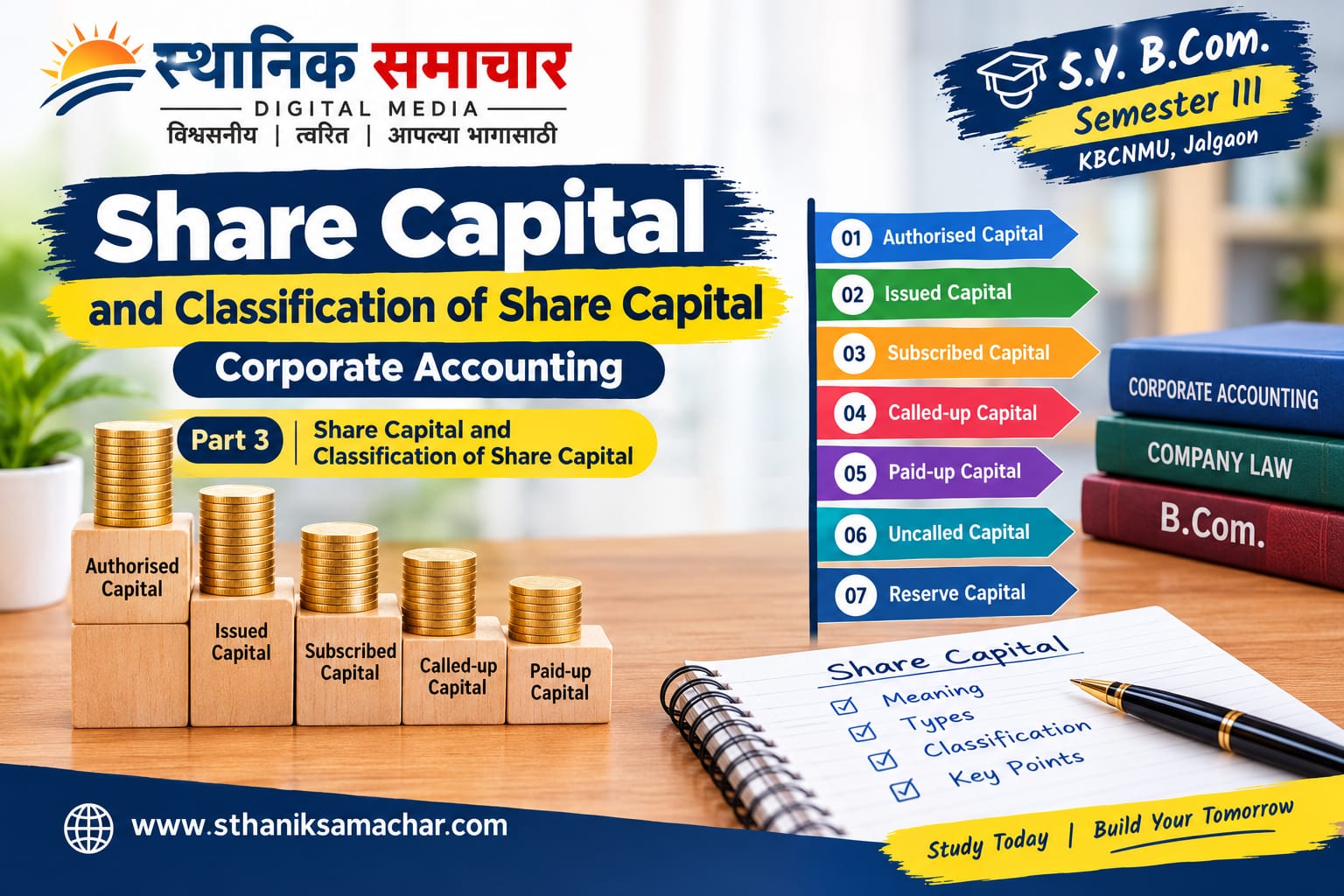
Understand the complete classification of Share Capital with clear explanations of authorised, issued, subscribed, called-up, paid-up, uncalled and reserve capital.
Introduction
Share capital is one of the most important sources of finance for a company. A company requires funds for starting its business, purchasing assets, meeting working capital requirements, expanding operations and carrying out various business activities. In the case of a company limited by shares, a major portion of long-term finance is raised by issuing shares to investors. The amount raised through the issue of shares is known as share capital. For students of Corporate Accounting, understanding the different classifications of share capital is essential because these terms are frequently used while recording share transactions and solving practical problems relating to issue, allotment, calls, forfeiture and reissue of shares.
Meaning of Share Capital
Share capital means the amount of capital raised by a company by issuing shares to its members or shareholders. When a company divides its capital into a number of units having a fixed face value and offers these units to investors, each unit is called a share. The aggregate nominal value of the shares issued by the company represents its share capital. For example, if a company issues 1,00,000 equity shares of ₹10 each, its share capital represented by those shares is ₹10,00,000. Share capital therefore represents the financial contribution or commitment of shareholders towards the company.
Share capital is different from the total value of the company’s assets. It specifically represents the capital structure arising from the issue of shares. The amount of share capital may change when the company issues additional shares, calls up further amounts on partly paid shares, forfeits shares, reissues forfeited shares or alters its capital structure according to applicable legal provisions.
Authorised Capital
Authorised capital is the maximum amount of share capital that a company is authorised to issue to shareholders according to its constitutional documents and applicable law. It is also known as registered capital or nominal capital. The company cannot normally issue shares beyond its authorised capital unless the authorised capital is appropriately increased.
For example, suppose a company has an authorised capital of ₹50,00,000 divided into 5,00,000 equity shares of ₹10 each. The company may issue shares up to this authorised limit, subject to applicable legal requirements. It is not necessary for the company to issue the entire authorised capital immediately. A company may initially issue only a portion of its authorised capital and issue additional shares later as its financial requirements increase.
Authorised capital therefore represents the upper limit within which the company can structure its share issue. It is important to remember that authorised capital does not mean the amount actually received by the company from shareholders.
Issued Capital
Issued capital represents that portion of the authorised capital which the company offers or issues to the public, shareholders or other investors for subscription. In other words, it is the part of authorised capital that has actually been made available for investment.
For example, if a company’s authorised capital is ₹50,00,000 consisting of 5,00,000 shares of ₹10 each, and the company issues 3,00,000 shares of ₹10 each, the issued capital will be ₹30,00,000. The remaining ₹20,00,000 remains unissued and forms part of the authorised capital.
Issued capital may therefore be equal to or less than authorised capital, but it cannot ordinarily exceed authorised capital without the necessary alteration of the authorised limit.
Subscribed Capital
Subscribed capital is the portion of issued capital that has actually been subscribed by investors and accepted by the company. When shares are offered for subscription, investors may apply for shares. The number of shares actually taken or subscribed by applicants and accepted by the company constitutes subscribed capital.
For example, if a company issues 3,00,000 shares of ₹10 each but applications are received and accepted for only 2,50,000 shares, the subscribed capital will be ₹25,00,000. The remaining 50,000 shares of the issued capital have not been subscribed.
In cases of full subscription, issued capital and subscribed capital may be equal. In cases of under-subscription, subscribed capital will be lower than issued capital.
Called-up Capital
Called-up capital refers to the amount of share capital that the company has demanded from shareholders to pay on the shares subscribed by them. A company does not necessarily have to collect the entire nominal value of a share at one time. It may collect the amount in instalments such as application money, allotment money and various calls.
For example, suppose a company issues shares of ₹10 each and has called ₹7 per share so far. If 1,00,000 shares are subscribed, the called-up capital will be ₹7,00,000. The remaining ₹3 per share has not yet been called and is known as uncalled capital.
Called-up capital is therefore concerned with the amount that the company has actually requested shareholders to pay, whether or not shareholders have actually paid the amount.
Paid-up Capital
Paid-up capital represents the amount of called-up capital that has actually been paid by shareholders and received or credited as received by the company. It is therefore possible for called-up capital and paid-up capital to differ when some shareholders fail to pay the amount demanded by the company.
For example, suppose a company has 1,00,000 shares of ₹10 each and has called ₹8 per share. The called-up capital is ₹8,00,000. If shareholders have actually paid ₹7,80,000 and ₹20,000 remains unpaid, the paid-up capital will be ₹7,80,000, subject to the applicable accounting presentation.
The difference between called-up capital and the amount actually paid by shareholders represents unpaid amounts, commonly referred to as calls in arrears where applicable.
Paid-up capital is particularly important because it indicates the amount of share capital actually paid or credited as paid on the shares.
Uncalled Capital
Uncalled capital is the portion of the subscribed share capital which has not yet been called by the company. When shares are issued as partly paid shares, the company may collect the remaining amount at a later date through one or more calls.
For example, a company issues shares having a face value of ₹10 per share. If it has called only ₹6 per share, the remaining ₹4 per share is uncalled. If 1,00,000 shares are subscribed, the uncalled capital will be ₹4,00,000.
Uncalled capital does not represent an amount presently payable by shareholders unless and until the company makes a call. It represents the amount that may become payable in the future according to the terms of the issue and applicable legal provisions.
Reserve Capital
Reserve capital is the portion of the uncalled capital of a company which, by resolution, is to be called only in the event of winding up of the company. It is therefore a special portion of uncalled capital kept available as additional protection for creditors in the event of liquidation.
For example, suppose a company has ₹10,00,000 of uncalled capital. If ₹4,00,000 of this amount is specifically designated as reserve capital, that amount will ordinarily be called only when the company is being wound up, subject to applicable legal provisions.
Reserve capital should not be confused with a capital reserve. Capital reserve is an accounting reserve arising from specified capital transactions, whereas reserve capital is a portion of uncalled share capital. This distinction is important from an examination point of view.
Nominal Capital
Nominal capital is another term commonly used for authorised capital. It represents the maximum share capital that the company is authorised to issue according to its constitutional and legal framework.
For example, if the authorised capital of a company is ₹1 crore divided into 10 lakh shares of ₹10 each, ₹1 crore represents its nominal capital. The company may issue only a part of this amount initially and increase its issued capital later within the authorised limit.
Thus, nominal capital indicates the registered or authorised ceiling of the company’s share capital rather than the amount actually received from shareholders.
Real Capital
The expression real capital is used in some traditional accounting explanations to refer to the capital that represents the actual amount of share capital raised or paid by shareholders, rather than merely the maximum authorised limit. In practical company accounting, students should understand the distinction between the authorised amount and the amount actually issued, subscribed, called and paid.
For examination purposes, real capital may therefore be understood in contrast with nominal or authorised capital. Nominal capital indicates the maximum authorised limit, whereas the actual capital position is reflected through the issued, subscribed, called-up and paid-up stages.
Students should follow the terminology and definition prescribed in their university textbook or study material when answering a question specifically using the term “real capital.”
Relationship Between Different Classes of Share Capital
The different classifications of share capital can be understood as a sequence. Authorised capital represents the maximum amount up to which the company is authorised to issue shares. Out of this, the company may issue a particular portion, which is known as issued capital. Investors may subscribe to all or part of the issued capital, giving rise to subscribed capital. The company may then call only a part of the subscribed amount, which is called-up capital. The amount actually paid by shareholders out of the called-up amount represents paid-up capital. The amount of subscribed capital that has not yet been called represents uncalled capital. A specified portion of uncalled capital may become reserve capital if it is formally designated to be called only in the event of winding up.
The relationship can be represented as:
Authorised Capital → Issued Capital → Subscribed Capital → Called-up Capital → Paid-up Capital
At the same time:
Subscribed Capital – Called-up Capital = Uncalled Capital
And, where applicable:
Called-up Capital – Amount Unpaid = Paid-up Capital
These relationships are extremely useful while solving practical problems in Corporate Accounting.
Illustrative Example
Suppose ABC Ltd. has an authorised capital of ₹50,00,000 divided into 5,00,000 equity shares of ₹10 each. The company issues 4,00,000 shares of ₹10 each. Applications are received and accepted for 3,50,000 shares. The company calls ₹8 per share and shareholders pay ₹7.50 per share on average because ₹0.50 per share remains unpaid.
In this example, the authorised capital is ₹50,00,000 because this is the maximum capital authorised by the company. The issued capital is ₹40,00,000 because 4,00,000 shares have been issued. The subscribed capital is ₹35,00,000 because 3,50,000 shares have been subscribed. The called-up capital is ₹28,00,000 because ₹8 has been called on each of the 3,50,000 shares. If ₹26,25,000 has actually been paid, the paid-up capital is ₹26,25,000 and the unpaid amount is ₹1,75,000. The uncalled amount is ₹2 per share, or ₹7,00,000 in total, because ₹10 is the nominal value and only ₹8 has been called.
This example demonstrates how the various forms of share capital are connected with each other.
Importance of Classification of Share Capital
Classification of share capital is important because it provides a clear picture of the company’s capital structure and the amount of capital that has been authorised, issued, subscribed, called and actually paid. It helps shareholders, management, creditors, accountants and other stakeholders understand the financial position relating to share capital.
From an accounting perspective, these classifications are also necessary for recording transactions relating to share applications, allotment, calls, calls in arrears, calls in advance, forfeiture and reissue of shares. A proper understanding of these terms makes the practical problems of Corporate Accounting much easier to solve.
Important Differences at a Glance
| Basis | Capital | Meaning |
|---|---|---|
| Maximum authorised limit | Authorised/Nominal Capital | Maximum capital the company is authorised to issue |
| Offered for subscription | Issued Capital | Portion of authorised capital issued by the company |
| Taken by investors | Subscribed Capital | Portion of issued capital subscribed by shareholders |
| Amount demanded | Called-up Capital | Amount called from shareholders |
| Amount actually paid | Paid-up Capital | Amount actually paid or credited as paid |
| Not yet demanded | Uncalled Capital | Portion of subscribed capital not yet called |
| Kept for winding up | Reserve Capital | Portion of uncalled capital designated to be called only on winding up |
Examination-Oriented Questions
Short Answer Questions
- What is meant by share capital?
- Define authorised capital.
- What is issued capital?
- Explain subscribed capital.
- What is called-up capital?
- Define paid-up capital.
- What is uncalled capital?
- Explain reserve capital.
- What is nominal capital?
- Distinguish between reserve capital and capital reserve.
Long Answer Questions
- Explain the meaning of share capital and discuss its various classifications.
- Explain authorised, issued, subscribed, called-up and paid-up capital with suitable examples.
- What is uncalled capital? Explain its relationship with reserve capital.
- Distinguish between authorised capital, issued capital, subscribed capital, called-up capital and paid-up capital.
- Explain nominal capital and real capital in the context of company share capital.
Quick Revision
Share capital is the capital raised by a company through the issue of shares. Authorised or nominal capital is the maximum amount of capital the company is authorised to issue. Issued capital is the portion offered for subscription. Subscribed capital is the portion taken up by investors. Called-up capital is the amount demanded from shareholders. Paid-up capital is the amount actually paid. Uncalled capital is the amount not yet demanded from shareholders. Reserve capital is a specified portion of uncalled capital that is intended to be called only in the event of winding up. Understanding these terms is fundamental to studying the accounting treatment of issue, calls, forfeiture and reissue of shares.
Conclusion
Share capital forms the foundation of the capital structure of a company. Its classification into authorised, issued, subscribed, called-up, paid-up, uncalled and reserve capital enables the accountant and other stakeholders to understand the different stages through which share capital passes from authorisation to actual payment. For S.Y. B.Com Semester III students, a clear understanding of these concepts is essential not only for theory questions but also for practical problems involving issue of shares, calls in arrears, calls in advance, forfeiture and reissue of shares. A strong grasp of share capital classification therefore provides an important foundation for the subsequent chapters of Corporate Accounting.

प्रकाश खिलारे हे स्थानिक समाचार डिजिटल मीडिया चे सहसंपादक असून सामाजिक, राजकीय, शैक्षणिक आणि स्थानिक घडामोडींवरील बातम्यांचे वृत्तांकन करतात. जनसामान्यांच्या प्रश्नांना वाचा फोडणे, स्थानिक पातळीवरील महत्त्वाच्या घटनांची अचूक माहिती वाचकांपर्यंत पोहोचवणे आणि निष्पक्ष पत्रकारितेच्या माध्यमातून समाजाशी जोडलेले राहणे हा त्यांच्या लेखनाचा मुख्य उद्देश आहे. डिजिटल पत्रकारितेच्या माध्यमातून ते विविध विषयांवर सखोल आणि प्रभावी बातम्या प्रकाशित करतात. आपण आपल्या परिसरातील बातम्या, माहिती तसेच लेख देण्याकरिता संपर्क करू शकतात…..
मो. 9112225235
Email- prakaashkhilare@gmail.com